Few essential oils appear across as many finished-product categories as lemongrass. The same drum can feed a household cleaner, a bar soap, a beverage flavour, a candle and a pet shampoo, which is why formulators who work across categories buy it in kilo and drum quantities rather than sampling it repeatedly. That breadth is also the reason bulk lemongrass oil is easy to specify badly. A citral figure that suits a cleaning concentrate can breach a sensitiser limit in a leave-on cosmetic, and a lot bought for a candle line may not carry the documentation a food application requires. The material is cheap and versatile. The specification is where the money is made or lost.
What you are buying when you buy lemongrass by the kilo
Lemongrass oil is defined commercially by its citral content, the combined geranial and neral fraction, which typically accounts for around 70 percent of the oil.
Our own GC/MS records put geranial at 36 to 43 percent with a typical value of 40, and neral at 28 to 34 percent with a typical value of 32. Geraniol runs 2 to 8 percent and geranyl acetate 2.5 to 6.5 percent. Physical constants are specific gravity 0.870 to 0.915, refractive index 1.470 to 1.500, and optical rotation minus 5 to 0 degrees.
Two commercial species circulate under the same trade name and they are not identical, so the botanical belongs on the purchase order alongside the citral range. Species, origin and harvest all move the aldehyde balance, and a 7 point swing in geranial is perceptible in a finished blend. If your line runs a signature scent, hold a retained reference lot and check deliveries against it.

The citral specification and its IFRA consequence
Citral is a declared fragrance allergen and an IFRA-restricted material, so the same figure that makes lemongrass commercially useful also sets the ceiling on how much you can use in a skin-contact product.
Our safety data records skin sensitisation for the material and directs formulators to the current IFRA standards for permitted concentrations, which vary by product category rather than applying as a single number. A rinse-off soap and a leave-on body oil sit in different categories with different limits, and a formulator working from one figure across a whole range will overshoot somewhere.
The practical discipline is to fix the usage rate per product category, not per raw material, and to recheck it whenever the IFRA standard is amended. Allergen declaration thresholds are separate from IFRA limits and trigger at lower concentrations, so a blend can be fully IFRA compliant and still require a citral declaration on pack. The same specification logic applies to other marker-compound oils, as our guide to carvacrol content in oregano oil sets out.
Where the kilo volume actually goes
Lemongrass earns drum-scale purchasing because it works across four distinct manufacturing categories, each with a different specification priority.
-
Home care and cleaning concentrates. The largest volume use. Citrus-adjacent aromatic profile with degreasing properties, dosed into detergents, dish soaps and surface products. Specification priority is cost per kilo and batch odour consistency.
-
Personal care and soap. Bar soap, shampoo and body products. Specification priority is the IFRA position and the allergen declaration, since these are skin-contact.
-
Home fragrance. Candles and room fresheners. Specification priority is flash point, which our records put at 79 degrees Celsius, placing the material in flammable liquid Hazard Category 4 with the packaging and freight consequences that follow.
-
Flavour applications. Beverages, teas, confectionery and savoury products. Specification priority is food grade status and documentation.
Lemongrass also appears in household and outdoor product formulations. Where those products make any pest-related claim, EPA registration under FIFRA, including assessment against the 25(b) minimum risk exemption, is the manufacturer's responsibility rather than the raw material supplier's. We document the chemistry; the registration pathway sits with the brand.
Documentation and handling for a kilo-plus order
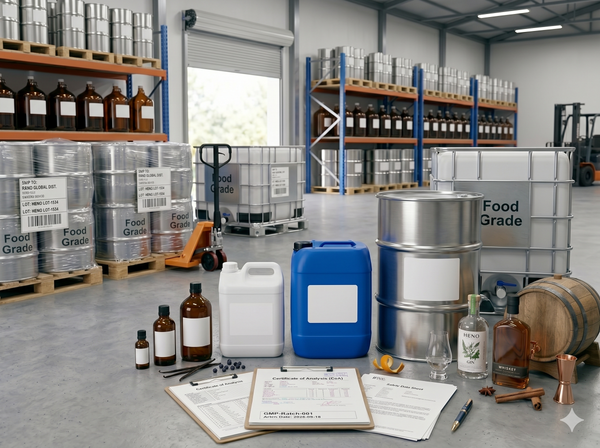
Four documents should arrive with a bulk lemongrass order: the batch CoA with the GC/MS profile, the SDS, the IFRA certificate, and the allergen declaration.
The CoA is the only document that tells you what this specific lot contains rather than what the material usually contains. Our QC team runs GC/MS in house on every lot before release, and CoA and SDS ship with every order. Batch testing against a retained reference is available on request.
Handling matters at volume. The material is a flammable liquid, incompatible with strong oxidising and reducing agents, and it should be stored cool, sealed and away from ignition sources. Kosher certification is held through EarthKosher for this product, and cosmetic grade status is confirmed. Organic status is separate and should be verified per SKU rather than assumed, since we supply both conventional and organic lemongrass. Extraction method also affects the profile, as our comparison of cold-pressed and steam-distilled oils explains.
Sourcing bulk lemongrass oil from HBNO
We manufacture from a 100,000 square foot facility in Chico, California, operating under ISO and GMP systems with FDA registration. Lemongrass is available as conventional and organic essential oil, as a natural fragrance, and as an organic floral water, so a brand working across categories can source the whole set from one qualified supplier.
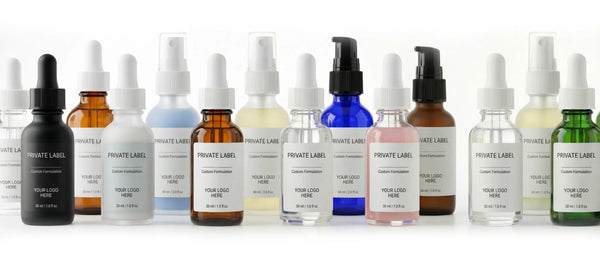
There is no minimum order quantity, which lets a formulator qualify the material at sample scale and move to drums without changing supplier. Our private label operation fills to 250,000 units per day, and the wider product list covers the adjacent citral-forward oils. PhD staff and in-house quality control mean specification questions are answered by the people who ran the analysis.
Frequently asked questions about bulk lemongrass oil
What citral content should a bulk lemongrass specification call for?
Combined geranial and neral of roughly 70 percent is typical, and our records show geranial at 36 to 43 percent and neral at 28 to 34 percent. Write the range rather than a single figure, because harvest and origin move it. Then confirm the actual value for each delivered lot on the batch CoA.
Why does the same lemongrass oil have different usage limits in different products?
Because IFRA limits are set per product category based on exposure, not per raw material. A rinse-off soap, a leave-on lotion and a candle all sit in different categories with different permitted concentrations. Fix the usage rate per product rather than adopting one figure across a range.
Does lemongrass oil need to be organic for a cosmetic application?
No. Organic certification governs cultivation and handling, not cosmetic suitability, and conventional lemongrass is cosmetic grade. Organic matters when the finished product carries an organic claim, in which case the certificate chain has to be traceable to the specific lot.
What flash point issues arise when shipping lemongrass in volume?
Our records put the flash point at 79 degrees Celsius, which classifies it as a Category 4 flammable liquid. That classification carries through to packaging, labelling and freight class, and it follows any blend the oil goes into. Confirm the classification of the finished blend, not just the raw material.
Can one lot serve both a cleaning line and a food application?
Only if that lot carries food grade documentation. Our lemongrass essential oil is FEMA GRAS listed and food grade, so a single qualified lot can serve both, which is a large part of why buyers order it by the kilo. Verify the status per SKU, since not every material in the range holds it.
HBNO's Food Grade Essential Oils are concentrated ingredients listed by the U.S. Food and Drug Administration ("FDA") as "Generally Recognized as Safe." These ingredients can be used in food applications according to guidelines set forth by the FDA and the Flavor and Extract Manufacturers Association. For commercial use, please consult industry guidelines, such as FEMA, for information related to the safe use of these concentrated ingredients.
Specifying bulk lemongrass oil before you scale the order
Buying lemongrass by the kilo makes sense precisely because one qualified material can serve four manufacturing categories. What makes it work is writing the specification to the strictest of those categories rather than the cheapest. Fix the citral range, hold the botanical constant, set usage rates per product category against the current IFRA position, and confirm food grade status per SKU before a flavour application relies on it. For current pricing, specifications or samples of bulk lemongrass oil, contact our team for a quote.
Published by the HBNO editorial team. HBNO (IL Health & Beauty Natural Oils Co., Inc.) is a manufacturer and bulk supplier of essential oils and carrier oils based in Chico, California.