Rosemary is the most requested essential oil in hair care right now, which means it is also the one most brands source badly. Demand arrives faster than procurement discipline does, and the pattern is predictable: a brand launches on a sample lot, the product sells, the reorder arrives smelling different, and the customer reviews register it before the QC log does. The brands that convert rosemary demand into a durable bestseller do one thing differently. They stop buying bulk rosemary oil as a botanical name and start buying it as a specification. Here is how that shift works in practice, using a composite of what we see across hair care programmes.
The starting position: one SKU and no specification
Most rosemary hair care products launch against a purchase order that names the botanical and the quantity, and nothing else.
That is enough to get a first production run out. It is not enough to reproduce it. Rosemary oil varies substantially by origin, harvest and distillation, and the constituent that varies most is the one that dominates the odour profile. A brand that liked its first lot has no mechanism to ask for the same thing again, because it never recorded what it received.
The failure surfaces at reorder two or three. The new lot is compliant, genuine, correctly labelled rosemary oil, and it smells noticeably different in a leave-in product at 2 percent. The brand now has a choice between accepting a sensory change its customers will notice or reformulating around a moving target. Neither is a good position, and both were avoidable at the purchase order stage.

What changed: locking the chemotype
Rosemary is defined commercially by its 1,8-cineole and camphor balance, and fixing that balance in the specification is the single change that stabilises a hair care product.
Our GC/MS records for rosemary essential oil show 1,8-cineole at 45 to 55 percent with a typical value of 52, alpha-pinene at 9 to 14 percent, camphor at 5 to 15 percent with a typical value of 5.5, and camphene at 2.5 to 6 percent. Physical constants are specific gravity 0.895 to 0.925, refractive index 1.460 to 1.480, and optical rotation minus 5 to plus 10 degrees.
Note the camphor range: 5 to 15 percent is a threefold spread, and camphor is assertive. A lot at the top of that range reads sharply different from one at the bottom. We supply three distinct rosemary forms, standard, organic and a camphor type, and they are not interchangeable. The brand in question fixed its specification to the cineole-dominant profile with camphor held to the lower half of the range, wrote it onto every purchase order, and held a retained reference sample. Reorder variance essentially stopped being a topic. Our guide to bulk rosemary oil pricing and supplier qualification covers the commercial side of the same decision.
The reorder curve, and what it did to procurement
A hair care bestseller generates a demand curve that is forecastable within a few months, and forecastability is what converts a spot buyer into a contract buyer.
The commercial mechanics are straightforward. Spot purchasing means paying spot prices and accepting whatever lot is available, which reintroduces the variance the specification was written to remove. Once a brand can predict quarterly consumption within a reasonable band, it can commit to a supply agreement, and a supply agreement is what makes lot reservation and consistent chemotype supply practical.
The sequence that works: launch on a documented specification, track actual consumption for two quarters, then convert to a recurring wholesale programme with the reference lot held on both sides. At HBNO we run long-term supply contracts and recurring wholesale programmes for exactly this pattern, and batch testing against a retained reference is available on request. Our account of how a hair care brand launched five products in ninety days follows the range-expansion version of the same story.
What the brand documents, and what it does not claim
Locking the specification solves the supply problem; it does not license a performance claim, and the distinction matters more in this category than in almost any other.
Rosemary in hair care sits alongside a large volume of consumer conversation about hair growth and thickness. Those are structure and function claims. They move a cosmetic toward drug classification under FDA rules, and they are not claims we substantiate or support for any raw material we supply. A brand that builds its marketing on them is building on a liability rather than an asset.
What a brand can document is substantial: botanical source, chemotype, GC/MS constituent profile with ranges, allergen declaration, IFRA position for the leave-on category at the intended usage rate, and lot traceability across every material in our formulations and single oil ranges. That is a genuinely defensible quality story, and in our experience it converts as well as an unsupportable performance claim while carrying none of the exposure. Aromatic load in a leave-in hair product typically runs 1 to 3 percent, constrained by the IFRA standards position on the specific materials rather than by preference.

Sourcing bulk rosemary oil from HBNO
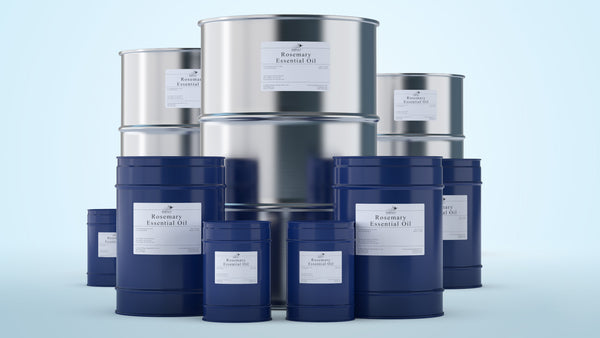
We manufacture from a 100,000 square foot facility in Chico, California, operating under ISO and GMP systems with FDA registration, with PhD staff and in-house quality control. Rosemary is available as standard and organic essential oil, as a camphor type, as a natural fragrance, as a verbenone floral water, and as extract, powder and oleoresin grades, which lets a brand build a range without adding suppliers. The essential oils range covers the aromatic forms.
Three points matter for a hair care programme. Every lot is GC/MS tested in house and ships with a CoA and SDS. There is no minimum order quantity, so a chemotype can be evaluated at sample scale first. And our private label operation fills to 250,000 units per day with drop-shipping available, which is often how a bestseller absorbs a demand spike without a capital project.
Frequently asked questions about bulk rosemary oil for hair care
What does chemotype mean on a rosemary oil purchase order?
It identifies which constituent profile you are buying. Rosemary occurs in cineole-dominant and camphor-dominant forms, and the two smell materially different in a finished product. Naming the chemotype and specifying the acceptable range for 1,8-cineole and camphor is what makes a reorder reproducible.
Why did our second rosemary lot smell different from the first?
Almost certainly because the constituent balance moved within the material's normal range. Camphor alone can run from 5 to 15 percent. Both lots can be genuine and compliant while reading differently at 2 percent in a leave-in product. The fix is a written specification plus a retained reference sample, not a change of supplier.
At what point should a brand move from spot buying to a supply agreement?
Once quarterly consumption is predictable within a reasonable band, usually after two quarters of real sales data. Before that, forecasts are guesses and a commitment risks dead inventory. After that, an agreement buys lot consistency and pricing stability, which are worth more than a spot discount.
What aromatic load do leave-in rosemary hair products use?
Typically 1 to 3 percent of the finished formula. The ceiling comes from the current IFRA position for the specific materials in a leave-on category and from the allergen declaration threshold. Document the rate and revisit it whenever the applicable standard is amended.
Which rosemary form suits a hair care range best?
The cineole-dominant standard or organic essential oil is the usual choice for leave-on hair products, with camphor held in the lower half of its range. The camphor type suits different applications. Evaluate both at sample scale in the actual base before committing, since the base changes how the profile reads.
Turning bulk rosemary oil into a product that reorders
The difference between a rosemary product that sells once and one that becomes a bestseller is not the marketing. It is whether the purchase order names a specification or a botanical. Fix the cineole and camphor ranges, hold a retained reference, convert to a supply agreement once demand is forecastable, and build the quality story on documentation rather than on claims you cannot substantiate. To review chemotype options or request samples of bulk rosemary oil, contact our team for a quote.
Published by the HBNO editorial team. HBNO (IL Health & Beauty Natural Oils Co., Inc.) is a manufacturer and bulk supplier of essential oils and carrier oils based in Chico, California.