Skincare manufacturers sourcing rosemary essential oil for topical formulations need one number before anything else: verified 1,8-cineole content. The skin-balancing, antioxidant, and skin-tone applications that drive rosemary oil demand in the professional skincare segment depend entirely on that constituent being within specification at the point of manufacture. A supplier who ships without GC/MS documentation is asking your formulation chemist to accept an unknown. At HBNO, every lot of bulk rosemary essential oil is GC/MS tested in-house before it leaves our 100,000 sq ft facility in Chico, California, with a batch-specific CoA included at no extra cost.
Rosemary Essential Oil Chemistry for Skincare Formulations
The three constituents that matter most to skincare formulators sourcing bulk rosemary essential oil are 1,8-cineole (also called eucalyptol), α-pinene, and camphor and their relative proportions define which formulation applications the batch is suitable for.
Research published in Environmental Toxicology and Pharmacology identified the following constituent profile for steam-distilled rosemary essential oil (Rosmarinus officinalis L.): 1,8-cineole at 26.54% of the total composition, α-pinene at 20.14%, with camphor as a tertiary contributor (Jardak et al., 2011, Environ Toxicol Pharmacol, 32:63–8). Commercial batches sourced from Tunisia and Morocco HBNO's primary origins, typically run 1,8-cineole at 20–45% depending on harvest season and altitude.
What each constituent delivers in a skincare formulation:
-
1,8-cineole (eucalyptol): The key constituent considered for oily-feeling, combination, and shine-conscious skin. It contributes a fresh, camphoraceous aroma and may be evaluated as part of a formulation’s sensory profile and overall ingredient selection.
-
α-pinene: A key aromatic constituent that contributes to rosemary essential oil’s clean, resinous character. It helps shape the herbal fragrance profile formulators may use to anchor fresh, botanical scent compositions.
-
Camphor: Contributes a fresh, cooling sensory note and is relevant for body-care, scalp-care, and aromatic personal-care formulations.
INCI name on finished product labels: Rosmarinus officinalis (Rosemary) leaf oil. Latin binomial on first mention in any formulation guide should use the current synonym where required: Salvia rosmarinus is accepted in newer taxonomic classifications.

Skincare Formulation Applications for Bulk Rosemary Essential Oil
Bulk rosemary essential oil may be considered for oily-feeling and shine-conscious skincare, skin-conditioning formulations, scalp-care products, and aromatic body-care products. Its constituent profile can be evaluated as part of fragrance, sensory, and overall formulation-design considerations.
In our experience working with skincare formulators, the most commercially productive applications are:
Oily-feeling and shine-conscious skincare: Rosemary essential oil may be considered for facial serums, cleansers, and toners where a fresh, herbal aromatic profile is desired. Typical use levels should be determined by the finished formula, applicable fragrance guidance, and product-specific safety assessment. Patch testing and sensitization evaluation at the proposed use concentration are standard formulation considerations.
Skin-conditioning formulations: Rosemary essential oil may be blended with carrier oils such as argan, rosehip, or vitamin E-containing ingredients to create premium facial and body-care formulations with a botanical aroma profile.
Scalp-care and hair-conditioning products: Rosemary essential oil is used in scalp serums, hair oils, and rinse-off hair-care products. Formulators may evaluate camphor and 1,8-cineole levels as part of their fragrance, sensory, and finished-product safety criteria.
Aromatic massage and body-care products: Camphor and 1,8-cineole contribute fresh, cooling and warming sensory notes that can complement massage oils and body-care formulations. Organic grades may be selected by brands seeking certified-organic ingredient option
From our production facility in Chico, we supply rosemary oil to manufacturers in the skincare, hair care, food and beverage, and aromatherapy industries across North America, Europe, and Asia.

HBNO's Bulk Rosemary Essential Oil Supply Credentials
HBNO supplies steam-distilled rosemary essential oil sourced from Tunisia, Morocco, Spain, and India, in both conventional and USDA Organic grades, GC/MS tested on every batch, with CoA, SDS, and IFRA compliance documentation included.
Key supply specifications:
-
Botanical species: Rosmarinus officinalis (syn. Salvia rosmarinus) L.
-
Extraction method: Steam distillation from leaf/flowering tops
-
Key constituent range: 1,8-cineole 20–45%; α-pinene 15–25%; camphor 5–15% — all verified by in-house GC/MS
-
Certifications: ISO, GMP, FDA, Kosher, FEMA/GRAS (food-grade); USDA Organic for the organic grade
-
Documentation: Batch-specific CoA + GC/MS report + SDS + IFRA compliance sheet on every shipment
Across our private-label production lines, rosemary essential oil is one of the most frequently specified botanical ingredients. We've built supply redundancy across multiple cultivation origins so that seasonal harvest variation doesn't become a production stoppage for your team.
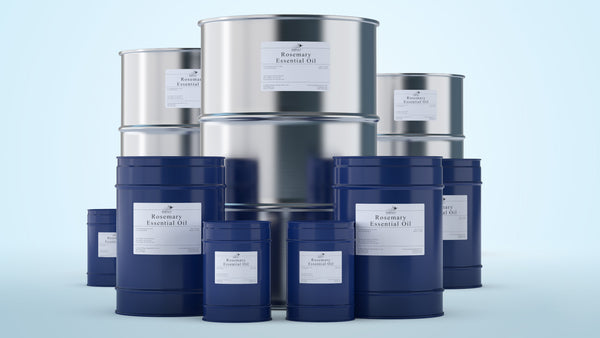
HBNO has no minimum order quantity, your formulation chemist can request a 4 oz sample of the same product batch your production team will scale to. We supply from trial through 25 kg containers and drum quantities.
Browse our full range of USDA Certified Organic Essential Oils for organic rosemary and companion botanicals in a single supplier relationship.
FAQ
What 1,8-cineole percentage should skincare formulators specify for bulk rosemary essential oil?
A 1,8-cineole content of 20–45% is the normal range for commercially traded steam-distilled rosemary essential oil from Mediterranean origins. For skincare applications, the high end of that range (35–45%) is preferred. For scalp-sensitive or leave-on facial formulations where penetration needs to be modulated, a mid-range spec (20–30%) with higher α-pinene content is more appropriate. Request the GC/MS report before confirming any bulk order HBNO issues these with every shipment.
Is HBNO's bulk rosemary essential oil suitable for food and beverage manufacturing as well as skincare?
Yes. Our conventional and organic grades both carry FEMA/GRAS approval and Kosher certification, covering both cosmetic and food manufacturing. Dual-grade certification simplifies supplier qualification for companies operating across personal care and functional food or supplement product lines.
How does HBNO ensure batch consistency for rosemary essential oil across multiple orders?
We GC/MS test every production lot in our in-house laboratory. Constituent ranges are documented on the CoA so your QA team can verify each delivery against your approved specification. For accounts on long-term supply contracts, we can provide a master reference standard and constituent spec that ties your purchase orders to a verified band not a certificate of species alone.
What dilution rates apply for rosemary essential oil in leave-on facial skincare?
IFRA guidelines for leave-on skin applications and standard cosmetic formulation practice suggest dilution at 0.5–1% in a carrier oil for concentrated serum formats, and 0.1–0.5% in emulsion-based moisturisers. HBNO issues an IFRA compliance sheet with every shipment. Always consult relevant regulatory bodies for compliance requirements in your market before finalising label claims.
Can HBNO supply rosemary essential oil as part of a private-label finished product?
Yes. HBNO's private label services cover ingredient sourcing, in-house GC/MS testing, formulation development, filling, and branded packaging. Our 250,000 units per day production capacity supports everything from a pilot SKU run through full commercial launch, all under one supplier relationship.
Published by the HBNO Bulk editorial team. HBNO (IL Health & Beauty Natural Oils Co., Inc.) is a manufacturer and bulk supplier of essential oils and carrier oils based in Chico, California.