Rosemary essential oil (Rosmarinus officinalis) is a high-demand raw material across personal care, food manufacturing, and household product categories. For procurement teams, bulk rosemary oil is not a single commodity specification chemotype, origin, grade, and certification level all affect price, documentation requirements, and formulation suitability. The global essential oils market is projected to exceed $25 billion by 2030 (Grand View Research), with rosemary among the most actively traded B2B SKUs across three distinct industrial sectors. Understanding these variables before issuing a purchase order separates efficient sourcing from repeated qualification failures.
Rosemary Oil for Manufacturing: Applications and Chemotypes
The chemotype of bulk rosemary oil determines its application suitability ordering without specifying chemotype risks receiving a grade incompatible with your formulation.
Commercial rosemary oil is primarily produced as CT 1,8-cineole the dominant global supply grade, originating from Tunisia, Morocco, and Spain characterized by 45-55% 1,8-cineole content. This grade underpins hair care, scalp serums, food flavoring, and household cleaning applications. CT camphor, sourced from Spanish highland varieties, contains elevated camphor levels suited for different formulation functions and is not appropriate for food-grade use.
For food manufacturing, rosemary oil holds FEMA GRAS status as a flavoring ingredient under FDA regulations. Dual-grade certification covering both food and cosmetic specifications within a single lot simplifies inventory for brands operating across product categories. Always confirm whether a supplier's CoA covers food-grade or cosmetic specification, as the two carry different documentation requirements.

What Drives Wholesale Pricing for Bulk Rosemary Oil
Bulk rosemary oil pricing is not a fixed market rate it is determined by chemotype, origin, certification status, and batch volume, each of which procurement teams can actively influence.
Three origin regions dominate supply. Tunisia and Morocco produce the majority of CT 1,8-cineole at competitive price points; Spain supplies premium grades and CT camphor; India provides growing volumes of lower-priced conventional material. USDA Organic-certified rosemary oil commands a significant premium over conventional grades at equivalent batch sizes, driven by annual third-party audit requirements and smaller certified production volumes.
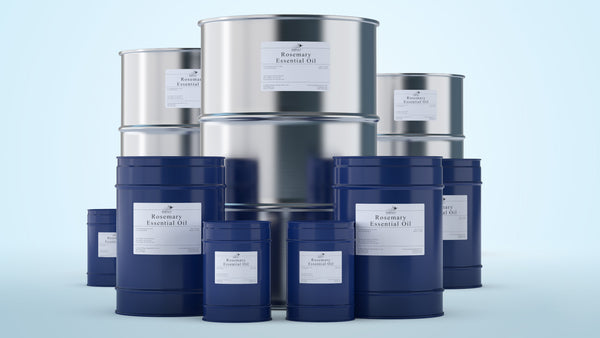
Volume tiers remain the most actionable pricing lever. Scaling from trial quantities to drum volumes typically 180 kg routinely yields 15-25% unit cost reductions at established suppliers. Long-term supply contracts with committed annual volumes provide further price stability against the seasonal harvest volatility common in Mediterranean rosemary cultivation, particularly during drought years in Moroccan and Tunisian sourcing regions.
Qualifying a Bulk Rosemary Oil Supplier: GC/MS Specifications and Documentation
A qualified bulk rosemary oil supplier provides batch-specific GC/MS data aligned to accepted marker compound ranges any supplier unwilling to share this should be removed from your shortlist.
The accepted specification for CT 1,8-cineole rosemary oil: 1,8-cineole at 45-55%, α-pinene at 9-14%, camphor below 15%, and β-pinene at 2-6%. Deviations outside these ranges indicate adulteration, varietal substitution, or chemotype misrepresentation. Common adulterants include carrier oil dilution, synthetic 1,8-cineole blending, and lower-quality distillate mixing all detectable via GC/MS, none visible through organoleptic or visual inspection alone. Optical rotation testing adds a secondary layer for chiral adulteration detection.
Required supplier documentation: batch-specific CoA, SDS, GC/MS report, IFRA conformance certificate for personal care and fragrance applications, and country of origin. At HBNO, our bulk rosemary oil is tested to full GC/MS specification and ships with all five documents as standard on every order.
Common Procurement Mistakes When Sourcing Rosemary Oil in Bulk
Most bulk rosemary oil qualification failures stem from under-specification at the purchase order stage not from supplier bad faith.
Four mistakes account for the majority of sourcing failures. First, not specifying chemotype: ordering "rosemary essential oil" without designating CT 1,8-cineole or CT camphor allows the supplier to select for you, and the received grade may not suit your formulation. Second, accepting a product specification sheet in place of a batch-specific GC/MS report a specification describes the product category, not the specific lot being received. Third, single-source dependency: rosemary is an agricultural crop subject to Mediterranean drought cycles; maintaining a qualified secondary supplier prevents production stoppages when primary supply is constrained. Fourth, skipping optical rotation testing: standard GC/MS may not detect chiral adulteration with synthetic 1,8-cineole requesting optical rotation values alongside GC/MS data adds a detection layer at no additional cost.
We recommend all wholesale buyers request a sample with full documentation before any production-scale commitment.

Why Manufacturers Source Bulk Rosemary Oil Through HBNO
HBNO supplies conventional and USDA Organic bulk rosemary oil from a 100,000 sq ft facility in Chico, California, with GC/MS verification, optical rotation testing, and full documentation on every order.
Our in-house QC team tests every batch for GC/MS composition, optical rotation, refractive index, specific gravity, and organoleptic profile. Every shipment includes a batch-specific CoA, SDS, GC/MS report, and IFRA conformance certificate. We carry no minimum order quantity, enabling brands to qualify a new grade or chemotype before committing to drum volumes.
For brands with organic positioning, our USDA Organic rosemary oil ships with organic transaction certificates and full lot traceability. We hold ISO, GMP, FDA, and FAIR FOR LIFE certifications and supply wholesale accounts globally. Long-term supply contracts and private label programs are available through our private label manufacturing program.
Frequently Asked Questions
What is the difference between rosemary oil CT 1,8-cineole and CT camphor for manufacturing?
CT 1,8-cineole is the dominant commercial grade, 45-55% cineole content used in hair care, food flavoring, and household cleaning formulations. CT camphor contains elevated camphor levels from Spanish highland varieties and is not suited for food-grade use. Always specify chemotype on purchase orders to ensure formulation alignment.
What GC/MS specifications should bulk rosemary oil meet for cosmetic formulation?
For CT 1,8-cineole: 1,8-cineole at 45-55%, α-pinene at 9-14%, camphor below 15%, β-pinene at 2-6%. Request batch-specific GC/MS reports rather than general specification sheets for each wholesale order. Deviations outside these ranges indicate adulteration or chemotype misrepresentation.
How do I identify adulterated bulk rosemary oil from a supplier?
Request batch-specific GC/MS analysis and optical rotation data. GC/MS detects carrier oil dilution and synthetic compound blending; optical rotation identifies chiral adulteration that GC/MS alone may miss. Suppliers who decline to provide both should be removed from your approved vendor list.
Is rosemary essential oil approved for use in food manufacturing?
Rosemary oil holds FEMA GRAS status as a food flavoring ingredient under FDA regulations. Food-grade applications require a dedicated food-grade CoA separate from cosmetic-grade documentation, with typical usage at 0.05-0.2% in the finished product. Confirm your supplier issues food-grade certification independently.
Can HBNO supply organic-certified bulk rosemary oil for private label production?
Yes. HBNO supplies USDA Organic rosemary oil with organic transaction certificates, lot-level traceability, and batch-specific GC/MS documentation available for wholesale bulk and private label production programs with no minimum order quantity.
Published by the HBNO Bulk editorial team. HBNO (IL Health & Beauty Natural Oils Co., Inc.) is a manufacturer and bulk supplier of essential oils and carrier oils based in Chico, California.
Sourcing bulk rosemary oil at production scale requires more than a competitive unit price it demands chemotype clarity, batch-level documentation, and a supplier whose quality controls hold across harvest years. For a wholesale quote, sample request, or documentation pack, contact the HBNO team to begin qualification.