Fragrance is the one category where a raw material bought badly can destroy the economics of an otherwise sound product. Bulk perfume oils are expensive per kilo, they are dosed at percentages that make small errors expensive, and the cost of getting the concentration decision wrong compounds across every unit filled. Brands lose margin here in three predictable ways: paying for concentration they do not need, committing to volume before a scent has proven itself, and reformulating because nobody checked the compliance position before the launch quantity was ordered. All three are avoidable at the purchase order stage.
Concentration is the whole cost model
The aromatic percentage in a finished fragrance, not the price per kilo of the oil, is what determines your cost per unit, and the two are frequently confused in procurement.
The conventional tiers run roughly as follows: an extrait or parfum at 20 to 30 percent aromatic concentration, an eau de parfum at 15 to 20 percent, an eau de toilette at 8 to 12 percent, and an eau de cologne at 3 to 5 percent. The rest is predominantly alcohol, with water and a small stabiliser fraction.
The arithmetic matters more than the naming. Moving a product from eau de parfum to eau de toilette can roughly halve the aromatic cost per unit while remaining a legitimate, well-understood market position. Conversely, a brand that specifies a parfum concentration because it sounds premium, then discovers its retail price cannot support the fill cost, has made an expensive positioning error that is very difficult to reverse once the pack is designed. Decide the tier from the target retail price backwards, not from the aspiration forwards.

Where the margin actually leaks
Three specific mistakes account for most of the margin loss in fragrance procurement: over-concentration, premature volume commitment, and late compliance discovery.
Over-concentration is the first, and it is often invisible because the product works. A brand running 18 percent where 12 would have satisfied its customers is paying a third more on its largest input for no commercial return. Test at three concentrations on a blind panel before fixing the specification.
Premature volume commitment is the second. Fragrance is the least predictable component of a launch, and a supplier minimum that forces a drum purchase before a scent has sold means the failed directions become write-offs rather than experiments. Our breakdown of volume tiers and cost per kilo shows where the tier breaks genuinely pay and where they only move cash into inventory. Late compliance discovery is the third and most expensive: finding after ordering that a material breaches the IFRA standards limit for your product category means reformulating a scent your marketing has already been built around. Check the position for the intended category before the order, not after.
Naturals, compounds, and what you are actually paying for
A bulk perfume oil can be a compounded fragrance, a natural essential oil, an absolute, or a blend of all three, and the cost drivers are completely different in each case.
Compounded fragrance oils are engineered to a fixed specification, which buys lot-to-lot consistency and a performance profile designed for your medium. For a brand whose signature scent has to be identical across three years of production, that consistency is worth real money.
Naturals bring provenance and harvest variability together. An absolute or a genuine single-origin oil such as Bulgarian lavender justifies a premium where the story is part of the product, but you should expect to reformulate periodically as the material moves. Our fragrances range covers the compounded side and the essential oils range the botanical side, both GC/MS tested in house with a CoA and SDS on every shipment.
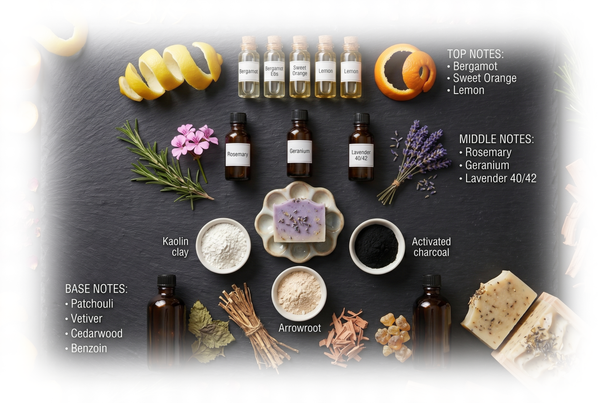
The blended approach is what most commercially successful brands actually do: a compounded base for structural reliability with measured natural additions for authenticity and label copy. Our guide to dilution rates and note profiles in commercial perfumery works through the construction.

Maceration, stability and the costs nobody budgets
A fragrance needs time and testing between blending and filling, and the schedule is a real cost that brands routinely omit from a launch plan.
Maceration is the resting period after the aromatic concentrate is combined with alcohol, typically several weeks, during which the composition settles and the profile changes measurably. Filling immediately produces a product that smells different from the approved submission. Chilling and filtration follow, to remove material that would otherwise cloud the finished liquid.
Then there is stability and packaging compatibility. Some aromatic materials discolour in clear glass under light, and some interact with pump and gasket materials. Both are cheap to test and expensive to discover after a production run. Flash point matters as well: a high-alcohol fragrance is a flammable liquid, and that classification determines packaging, labelling and freight, with the figure available on the SDS. For EU or UK sale, CLP classification consistent with the product's REACH status is required.
Sourcing bulk perfume oils from HBNO
We manufacture from a 100,000 square foot facility in Chico, California, operating under ISO and GMP systems with FDA registration, with PhD staff and in-house quality control. We supply compounded fragrances, single essential oils and absolutes, so a brand can build across all three without adding suppliers.
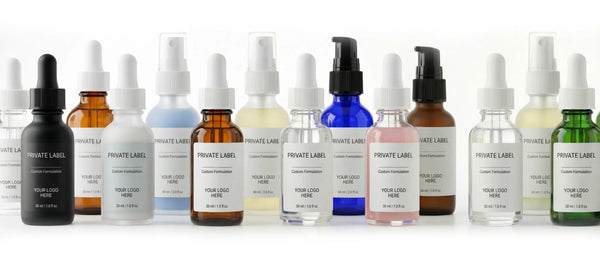
Three points speak directly to the margin problem. There is no minimum order quantity, which means six scent directions can be trialled and macerated at small scale before any volume is committed, and the failures cost samples rather than drums. Batch testing against a retained reference is available on request, which is how a signature scent survives three years of production. And our private label operation fills to 250,000 units per day with drop-shipping available, removing the maceration and filling infrastructure from your capital plan. The full product list covers adjacent materials.
Frequently asked questions about buying bulk perfume oils
What aromatic concentration should a new fragrance launch at?
Work backwards from the target retail price rather than from a desired tier. Eau de toilette at 8 to 12 percent supports a far wider range of price points than eau de parfum at 15 to 20 percent. Test at three concentrations on a blind panel, because customers frequently cannot distinguish the top two.
How long does a fragrance need to macerate before filling?
Commonly several weeks, and the exact period depends on the composition. The profile changes measurably during that time, so filling immediately produces a product that differs from the approved submission. Build the schedule into the launch plan rather than treating it as slack to be compressed.
Are compounded fragrance oils lower quality than natural essential oils?
No, they are different materials serving different purposes. Compounds are engineered to a fixed specification, which delivers consistency a harvest-dependent natural cannot. Naturals bring provenance and variability together. Most commercial brands use both, with a compounded base and measured natural additions.
Why would a fragrance go cloudy after filling?
Usually because chilling and filtration were skipped or were inadequate, leaving material that precipitates at lower temperatures. It can also indicate a compatibility problem with the packaging. Both are inexpensive to test before a production run and expensive to discover afterwards.
Does MOQ really affect fragrance margin that much?
More than in almost any other category, because fragrance is the least predictable part of a launch. A high minimum forces volume commitment on unproven scents, so failed directions become inventory write-offs instead of sample costs. Sourcing without a minimum converts that risk into an expense you control.
Buying bulk perfume oils on the right specification
Fragrance margin is won at the specification stage and lost in inventory. Set the concentration tier from your retail price backwards, blind-panel three levels before fixing it, confirm the IFRA position for your product category before you order rather than after, build maceration into the schedule, and avoid committing volume to a scent that has not sold. Do that and the most expensive input in the product stops being the riskiest one. To review options or request samples of bulk perfume oils, contact our team for a quote.
Published by the HBNO editorial team. HBNO (IL Health & Beauty Natural Oils Co., Inc.) is a manufacturer and bulk supplier of essential oils and carrier oils based in Chico, California.