Most reed diffusers underperform for a mechanical reason rather than a fragrance one. The reeds wick by capillary action, and capillary action is governed by viscosity and molecular weight, not by how much fragrance oil is in the bottle. A diffuser loaded with heavy base notes and no solvent will smell excellent when the cap comes off and do almost nothing at two metres a week later. For manufacturers specifying bulk reed diffuser oil, the blend architecture matters more than the concentration. At HBNO we supply the essential oils, natural fragrances, and carriers that go into these bases, and this is where most briefs need adjusting.
Why most reed diffusers stop throwing scent
Reed diffusers project scent only as fast as the liquid can climb the reed, so viscosity and molecular weight set the ceiling on performance before fragrance choice matters at all.
Three failures account for nearly all weak diffusers:
-
The base is too viscous. Undiluted fragrance oil, or a blend built on a heavy carrier, cannot climb a rattan reed at a useful rate. Diffuser bases are typically thin solvent systems rather than oils in the cosmetic sense.
-
The fragrance is too heavy. Sandalwood, patchouli, vetiver, and benzoin type materials are low volatility by nature. They anchor a blend beautifully and project almost nothing on their own.
-
The reeds saturate and stop. Once a reed is fully loaded and the top segment has gone tacky with oxidised oil, throw drops sharply. This is a formulation and reed specification issue, not a consumer error.
The practical consequence is that a good diffuser blend is deliberately front-loaded with volatile material and diluted to a viscosity that wicks. The fragrance load in a commercial diffuser typically sits between 20 and 30 percent of the finished liquid, with the balance carrying it up the reed.

Building a bulk reed diffuser oil blend that projects
A blend that throws needs a volatile top and heart fraction doing the projection, a small anchored base fraction giving it longevity, and a thin diluent making the whole thing wick.
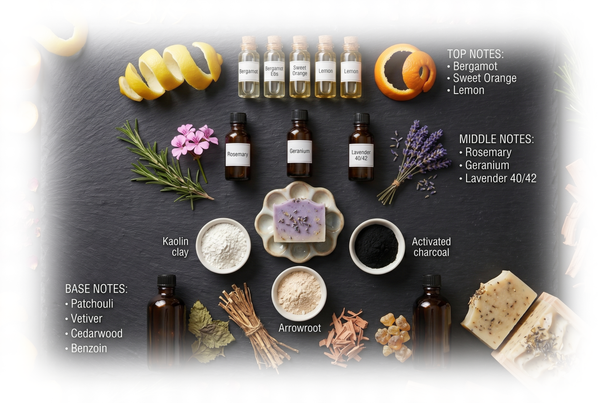
Working from our catalogue, the materials that earn their place divide clearly by role:
|
Role |
Materials |
Why it works in a diffuser |
|---|---|---|
|
Projection |
Orange, Lemon, Lime cold pressed, Pink Grapefruit, Eucalyptus Globulus, Peppermint |
High volatility, climbs and evaporates readily |
|
Heart |
Lavender, Lavender 40/42, Rosemary, Roman Chamomile |
Mid volatility, carries the character of the blend |
|
Anchor |
Cedarwood Virginia, Patchouli Dark, Clove Leaf, Cinnamon Bark |
Low volatility, extends longevity at low percentages |
|
Dilution |
Thin solvent base systems |
Reduces viscosity so capillary flow is possible |
Lavender 40/42 deserves a specific mention. It is a standardised blend rather than a single origin oil, which means the odour profile is consistent lot to lot. For a manufacturer running the same diffuser SKU for years, that consistency is worth more than the nuance of a varietal lavender. The same logic governs scaling one signature scent from small runs to production volume.
Keep the anchor fraction small. Cedarwood or patchouli at 3 to 8 percent of the fragrance load extends the life of a blend; at 20 percent it will flatten the throw entirely. The trade-off is the mirror image of a candle, where the heat of the flame does the volatilising work, which is why candle load rates do not transfer directly to a diffuser brief.
Specification and compliance for a diffuser programme
A diffuser is a leave-out consumer article with a flammable liquid inside, so flash point, IFRA category, and allergen declarations belong on the specification alongside odour.
Four documentation items should be settled before the first production order:
-
Flash point on each component and on the finished blend. This drives packaging, storage segregation, and freight classification. Our SDS states flash point per product.
-
IFRA category and usage limits. Diffusers fall under a different product category to leave-on cosmetics, and the IFRA Standards set limits by category. Restricted materials such as eugenol from clove or cinnamal from cinnamon bark need checking against the diffuser category, not a general figure.
-
Allergen declarations. Required for EU market entry and increasingly expected elsewhere. We can supply the declaration data for each component.
-
GC/MS identity on the natural components. Every essential oil we ship is GC/MS tested in house, with batch testing available on request, so a blend that has been qualified once can be reproduced.
European importers should also confirm their REACH obligations for the tonnages involved, since a diffuser programme at scale can cross registration thresholds that a cosmetic line at the same revenue would not.

Sourcing bulk reed diffuser materials from HBNO
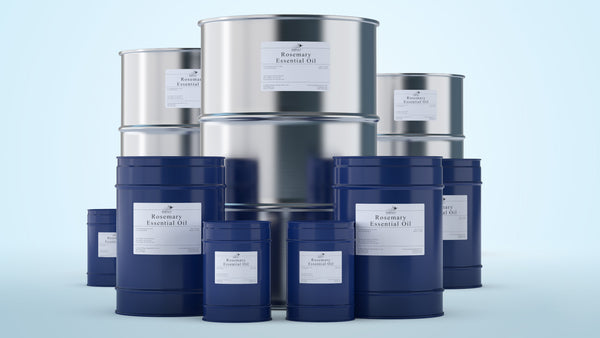
We manufacture and supply essential oils, natural fragrances, absolutes, and carriers from a 100,000 square foot facility in Chico, California, which lets a diffuser manufacturer source the whole aromatic side of a blend from one vendor.
HBNO holds ISO, GMP, FDA registration , Kosher, USDA Organic, and FAIR FOR LIFE certifications at company level, with PhD staff and in-house quality control. CoA and SDS are issued with every shipment, and certification status is confirmed per product rather than assumed across a range.
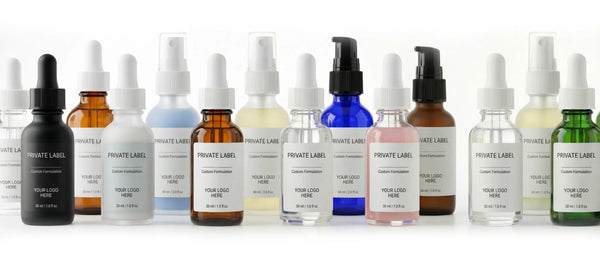
There is no minimum order quantity, so a manufacturer can trial several anchor percentages at bench scale before committing to volume. Private label capacity runs to 250,000 units per day, drop shipping is available, and we ship across North America, Europe, Asia, and Oceania. Diffuser programmes usually draw on both our fragrances range and the essential oils collection, and buyers frequently qualify a wax melt or candle line from the same materials, which is where hot throw and load rate work overlaps. Long term supply agreements suit diffusers well because a signature scent has to be reproducible for years.
Frequently asked questions about bulk reed diffuser oil
What fragrance load percentage does a commercial reed diffuser use?
Commercial diffusers commonly run a fragrance load of 20 to 30 percent of the finished liquid, with the balance made up of a thin diluent that allows capillary flow. Pushing the load higher usually reduces throw rather than increasing it, because viscosity rises and the reeds wick more slowly. The correct figure has to be established by trial on the specific reed and bottle combination.
Why do heavy base notes weaken a diffuser blend?
Materials such as patchouli, cedarwood, and vetiver have low volatility, which is exactly why they extend longevity in a fragrance. In a diffuser there is no heat source to volatilise them, so they climb the reed and largely stay there. Holding the anchor fraction to a small percentage of the fragrance load keeps longevity without sacrificing projection.
Which essential oils project best from a reed diffuser?
The high volatility materials do the projection work: cold pressed citrus oils such as orange, lemon, lime, and pink grapefruit, along with eucalyptus and peppermint. They evaporate readily from the exposed reed surface, which is what the consumer perceives as throw. Their trade-off is a shorter life, which is why a small anchored fraction is still needed.
How does IFRA compliance differ for diffusers compared with cosmetics?
IFRA sets usage limits by product category, and a room diffuser is a different category from a leave-on or rinse-off cosmetic. A restricted material may be permitted at a much higher or lower percentage depending on the category, so a limit carried over from a body product specification is not valid for a diffuser. Confirm the applicable category before setting the formula.
Can the same fragrance blend be used for candles and reed diffusers?
Rarely without adjustment. A candle relies on heat to volatilise the fragrance, so it tolerates and often benefits from a heavier base fraction. A diffuser relies on capillary action and ambient evaporation. The same accord usually needs reweighting toward volatile materials and diluting to a lower viscosity before it performs in a diffuser.
Specifying a diffuser blend that still works at week six
Bulk reed diffuser oil performance is decided by viscosity, volatility distribution, and reed compatibility, in that order. Build the blend with a dominant volatile fraction, hold the anchor materials to a small percentage, dilute to a viscosity that genuinely wicks, and confirm flash point and IFRA category before production. Our team can quote the essential oils and natural fragrances for each role, supply samples so the anchor percentage can be tested on your actual reeds, and provide the CoA, SDS, and allergen documentation a diffuser programme needs.
Request a bulk fragrance and essential oil quotation from HBNO.
Published by the HBNO editorial team. HBNO (IL Health & Beauty Natural Oils Co., Inc.) is a manufacturer and bulk supplier of essential oils and carrier oils based in Chico, California.