For candle producers scaling from bench batches to production, commercial candle making is a sourcing problem as much as a formulation one. Consistent scent throw, predictable burn, hazmat-compliant shipping, and IFRA documentation all depend on the oils you buy and the data your supplier provides. This guide covers the working rules, the flash point figures operators need, and the compliance paperwork buyers ask for. At HBNO, we supply fragrance-grade essential oils, absolutes, and natural fragrances to candle producers at every volume, with the certificates that make audits straightforward.
The 30/50/20 Rule in Commercial Candle Making
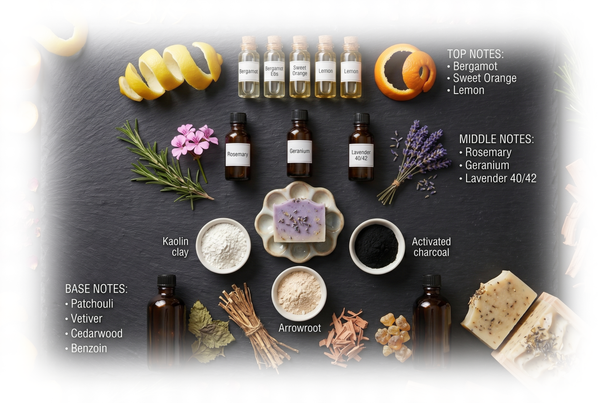
The 30/50/20 rule is a fragrance blending guideline, not a wax formula: it means building a scent from roughly 30% top notes, 50% middle (heart) notes, and 20% base notes so the fragrance opens brightly, holds through the burn, and leaves a lasting base.
This is worth stating clearly because the rule is often misread as a "30% fragrance load." That is incorrect and unsafe. In a real candle, fragrance is a small fraction of total weight. A typical commercial soy formulation looks like this:
-
Fragrance load: 6% to 10% of total weight (10% to 12% is the practical ceiling for most soy waxes)
-
Wax base: roughly 88% to 94%
-
Additives: 0% to 5% (dye, Vybar, UV inhibitor, stabilizers)
The 30/50/20 ratio applies only inside that fragrance fraction: citrus oils are top notes, lavender and rosemary sit in the heart, and woods such as cedarwood, patchouli, and vetiver form the base. Balancing the tiers gives a candle both cold throw on the shelf and hot throw when lit.

Best Fragrance and Essential Oils for Candle Making
The best essential oils for candle making combine strong throw, a higher flash point for easier handling, and stable pricing at volume, which is why citrus, woods, herbs, and warm spices dominate commercial candle fragrance oils.
Across our candle-manufacturing accounts, four oils recur as reliable anchors. Orange Essential Oil (Citrus sinensis) delivers a bright, low-cost top note. Cedarwood Virginia Essential Oil (Juniperus virginiana) is a dependable woody base with a high flash point. Lemongrass Essential Oil (Cymbopogon flexuosus) gives a fresh, high-impact heart note popular in clean and citronella-adjacent lines. Patchouli Dark Essential Oil (Pogostemon cablin) is a long-lasting base fixative. We stock these and the rest of our fragrances range in fragrance grade, GC/MS verified for batch-to-batch consistency.
Flash Point Data for Candle Manufacturing
Flash point is the temperature at which an oil's vapors can ignite, and it drives both transport classification and the temperature at which you add fragrance to wax, so every candle manufacturer should formulate from a supplier's measured data.
The table lists measured flash points and GHS flammability categories for 20 candle-relevant oils, drawn from HBNO batch data. Oils below 60 °C classify as flammable liquids for shipping; higher flash points ship and store more easily. Hazard classification follows the GHS and CLP framework maintained by ECHA.
|
Essential Oil |
Flash Point (°C) |
GHS Flammability |
Typical Note |
|
Pink Grapefruit |
43 |
Category 3 |
Top |
|
Siberian Fir Needle |
43 |
Category 3 |
Top |
|
Orange |
45 |
Category 3 |
Top |
|
Lemon |
48 |
Category 3 |
Top |
|
Eucalyptus Globulus |
50 |
Category 3 |
Top/Middle |
|
Bergamot |
58 |
Category 3 |
Top |
|
Lime (Cold Pressed) |
58 |
Category 3 |
Top |
|
Rosemary |
64 |
Category 3 |
Middle |
|
Tea Tree |
64 |
Category 4 |
Middle |
|
Lavender |
75 |
Not classified as flammable |
Middle |
|
Lemongrass |
79 |
Category 4 |
Middle |
|
Citronella |
85 |
Category 4 |
Middle |
|
Cinnamon Bark |
87 |
Category 4 |
Middle/Base |
|
Cassia |
90 |
Category 4 |
Middle/Base |
|
Peppermint |
91 |
Not classified as flammable |
Middle |
|
Cedarwood Virginia |
94 |
Not classified as flammable |
Base |
|
Copaiba Balsam |
94 |
Not classified as flammable |
Base |
|
Clove Bud |
100 |
Not classified as flammable |
Middle/Base |
|
Patchouli Dark |
100 |
Not classified as flammable |
Base |
|
Vetiver |
130 |
Not classified as flammable |
Base |
Our QC team measures flash point in house and reports it on the SDS and CoA with every shipment, so operators can set safe fragrance-addition temperatures and logistics can classify freight correctly.
IFRA Compliance for Candle Fragrances
IFRA compliance means each fragrance material is used within the concentration limits set for its product category, and candle manufacturers should require IFRA conformity documentation before scaling any new scent.
Candles fall under specific IFRA Standards categories that cap certain materials by exposure route. As a non-skin-contact category, many candle limits are more permissive than for leave-on cosmetics, but sensitizers such as cinnamaldehyde in cinnamon and cassia still carry restrictions. We issue IFRA conformity statements and allergen declarations on request, alongside the GC/MS reports an IFRA assessment depends on. Sourcing to REACH and IFRA expectations up front prevents reformulation mid-production.

Bulk Supply, MOQ, and Drum Formats for Candle Manufacturers
HBNO carries no minimum order quantity and ships candle fragrance oils from sample sizes to full drums, with live pricing quoted against current lots rather than a fixed list.
Candle programs scale unevenly, so we supply across formats to match your run size:
-
Sample and test quantities for new scent development
-
1 kg and 25 kg pails for pilot and small-batch production
-
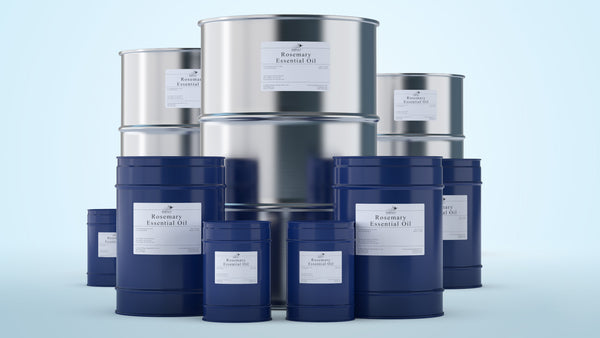
180 kg to 190 kg drums and IBC totes for full production lines
Because pricing shifts with harvest, origin, and volume, we quote candle-specific bulk pricing on request rather than a static per-kilogram figure. From our 100,000 sq ft Chico, California facility, HBNO holds ISO, GMP, FDA, Kosher, USDA Organic, and FAIR FOR LIFE certifications, runs private label up to 250,000 units per day, drop-ships, and ships globally, with GC/MS testing and a CoA and SDS on every shipment.
Frequently Asked Questions
What is the 30/50/20 rule for candles?
It is a fragrance blending guideline: build a scent from about 30% top notes, 50% middle notes, and 20% base notes so it opens, holds, and lingers. It is not a wax recipe and does not mean a 30% fragrance load, which would not bind to wax and would burn unsafely.
What fragrance load percentage should I use for soy candles?
Most soy waxes perform best at a 6% to 10% fragrance load by weight, with 8% a common starting point. The practical maximum is about 10% to 12%; above that, oil can sweat, clog the wick, and hurt throw. Confirm against your wax's stated maximum.
What essential oils work best for candles?
Citrus (orange, lemon, grapefruit), woods (cedarwood, patchouli, vetiver), herbs (rosemary, lavender), and warm spices (cinnamon, clove) are the most reliable. Higher flash point woods such as cedarwood, patchouli, and vetiver handle easily in production and act as base-note fixatives.
Can I get flash point data for candle manufacturing?
Yes. HBNO measures flash point in house and reports it on the SDS and CoA with every shipment, so your team can set safe fragrance-addition temperatures and classify freight under GHS and DOT rules. Batch-specific data is available on request before you order.
Which HBNO oils are supported by IFRA documentation?
We provide IFRA conformity statements and allergen declarations for applicable materials, backed by GC/MS reports. Because candles are a defined IFRA product category, we can confirm whether a material fits its limits for your candle format before you scale to production.
Published by the HBNO Bulk editorial team. HBNO (IL Health & Beauty Natural Oils Co., Inc.) is a manufacturer and bulk supplier of essential oils and carrier oils based in Chico, California.
Conclusion
Successful commercial candle making rests on three things a supplier controls: consistent fragrance chemistry, measured flash point data, and audit-ready IFRA documentation. Get the 30/50/20 blend and the 6% to 10% fragrance load right, and the rest is a sourcing decision. HBNO backs candle fragrance oils with GC/MS testing, batch flash point reporting, and no-minimum drum-scale supply. To match oils to your line and request bulk pricing, contact the HBNO team for a quote.