Sourcing fragrance oil for linen spray is where a lot of home-fragrance programmes quietly go wrong. The brief arrives written like a candle brief, the buyer sources on scent name and price per kilo, and the finished spray tests beautifully in the lab then smells like nothing on a pillowcase forty minutes later. The gap is not quality. Fabric is a different substrate from wax, air, or skin, and the properties that decide whether a scent stays are ones most purchase orders never mention. At HBNO we supply the woods, roots, and citrus that go into room and linen formulations, and this guide covers what holds on fabric and what to put on the specification.
Why Most Linen Sprays Stop Smelling Like Anything
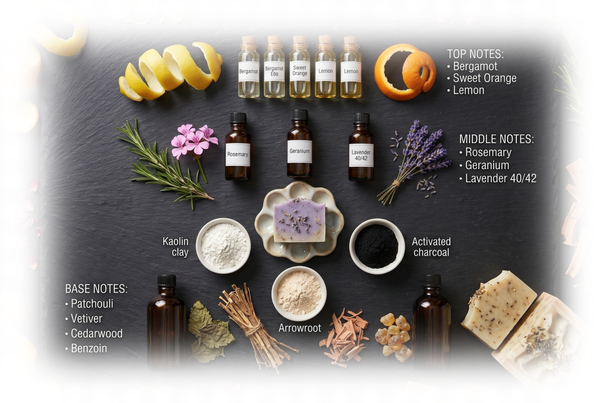
Scent tenacity on fabric is a volatility problem before it is a formulation problem. A linen spray deposits a thin film and leaves it exposed to open air with no occlusion, no warmth, and nothing to slow evaporation. Light citrus and herbal top notes, built largely from monoterpenes, evaporate within minutes. Heavier sesquiterpene alcohols and ketones evaporate over hours or days. A blend weighted toward the top of the pyramid will always read as short on fabric, however good it smells off a blotter.
The useful part for a procurement team is that a rough volatility ranking already sits on every Safety Data Sheet. Flash point tracks volatility closely enough to be a working proxy, and it costs nothing to compare. Our frankincense carterii sits at a 47 degree Celsius flash point and classifies as a Category 3 flammable liquid. Cedarwood Virginia sits at 94 degrees, patchouli at 100, and vetiver at 130, none classified as flammable under GHS. That spread is the same spread you will hear on a pillowcase eight hours later. Sorting a candidate list by flash point before anyone smells anything is a fast first filter, and the home fragrance category has grown fast enough that most brands now test more candidates than they have bench time for.

The Materials That Actually Stay on Fabric
The molecules that persist on textiles are high-molecular-weight sesquiterpene alcohols and ketones, and three HBNO materials carry them at specification level. These are worth writing into a brief by name rather than by scent description.
Cedarwood Virginia essential oil, steam distilled from Juniperus virginiana wood chips, carries alpha-cedrol at a typical 18 percent against a 16 to 25 percent range, alongside cis-thujopsene at a typical 20 percent. Cedrol is a crystalline sesquiterpene alcohol and is why a cedar-led accord still reads on linen the next morning. The oil is clear to pale yellow, which matters more than it sounds.
Patchouli dark essential oil from Pogostemon cablin runs patchouli alcohol at a typical 28 percent against a 27 to 35 percent range, with delta-guaiene and alpha-guaiene behind it, and is among the most tenacious naturals at commodity pricing. Vetiver essential oil, distilled from Vetiveria zizanioides roots in Haiti, is the most persistent of the three, carrying khusimol at 7 to 16 percent and beta-vetivone at 2 to 7 percent. Our vetiver CoA flags skin sensitisation, a live consideration for any spray misted onto bedding.
Fibre, Colour, and the Two Faults That Get a Batch Returned
Two problems account for most linen spray complaints, and neither is about scent. The first is staining. Patchouli dark runs orange to dark brown, and vetiver runs yellow through reddish brown. Both are superb on tenacity and both will mark white cotton at a careless usage rate. Cedarwood Virginia, clear to pale yellow, is the safer backbone for a white-linen product, with the darker materials dosed low or replaced by a colourless natural fragrance compound. Our fragrance range includes compounded versions of those profiles for exactly this reason.
The second is separation. A linen spray is overwhelmingly water and alcohol, and fragrance oil does not dissolve in it unaided. Without an adequate solubiliser the product hazes, rings the bottle, and deposits neat droplets that show as spots on fabric. The solubiliser ratio is the formulator's job, but the buyer influences it at the specification stage: ask for the material's colour range and specific gravity, and match a candidate to the water phase you are actually using. Where a formulation leans on a botanical water base, our note on buying hydrosols properly covers the aqueous side.

What to Specify When Buying in Bulk
A linen spray brief needs four lines a candle brief does not. Put these on the purchase order rather than discovering them at pilot scale:
-
Colour range on the CoA, stated as a range and not a single nominal value. This is the staining control.
-
Flash point and GHS classification. It is your volatility proxy, and it also decides how the drum ships.
-
The IFRA certificate for the material at your usage rate. Room and linen sprays sit in the household and air-care categories under the IFRA Standards, not the leave-on skin categories, and the applicable category depends on aerosol format and expected incidental skin contact. Our guide to IFRA standards for formulators explains how the categories map.
-
The allergen declaration, which drives label copy in the EU and UK. Fragrance ingredients placed on the EU market at volume also carry REACH obligations sitting with the importer.
Add specific gravity and refractive index to confirm identity on arrival, plus shelf life and storage. Ours run two years at 15 to 25 degrees Celsius across all three woods. Our note on cedarwood as a base note covers how these behave inside a wider accord.
How HBNO Supplies Bulk Fragrance Oil
We manufacture from a 100,000 square foot facility in Chico, California, with in-house PhD staff and GC/MS testing on every product we ship. Company certifications cover ISO, GMP, FDA, Kosher, USDA Organic, and FAIR FOR LIFE, and all three woods above are Kosher certified through EarthKosher and cosmetic grade. A batch-specific Certificate of Analysis and Safety Data Sheet ship with every order, with batch testing on request. We hold no minimum order quantity, which lets a brand qualify three tenacity candidates side by side before committing to a drum, and private label capacity runs to 250,000 units per day.
Frequently Asked Questions
What makes a fragrance oil hold its scent on fabric?
Molecular weight and volatility. Fabric offers no occlusion and no warmth, so the material evaporates into open air. High-molecular-weight sesquiterpene alcohols and ketones such as cedrol, patchouli alcohol, and khusimol evaporate slowly and stay detectable for hours. Monoterpene-heavy citrus and herbal materials evaporate within minutes, so a blend weighted toward top notes always reads as short on a pillowcase.
Why does a citrus linen spray fade faster than a woody one?
Because citrus oils are dominated by light monoterpenes with high vapour pressure and low flash points, typically well under 60 degrees Celsius. Woods sit far higher: our cedarwood Virginia is 94 degrees, patchouli 100, vetiver 130. Citrus can still open a linen accord, but it needs a woody or root-derived base behind it to carry past the first half hour.
How can a linen spray be formulated without staining white fabric?
Control colour at the raw material stage. Patchouli dark runs orange to dark brown and vetiver yellow to reddish brown, so both should be dosed low in a white-linen product or substituted with a colourless compounded natural fragrance. Cedarwood Virginia, clear to pale yellow, is the safer structural base. Adequate solubilisation matters equally, since undissolved droplets deposit as visible spots regardless of the oil's colour.
Which IFRA category applies to a room and linen spray?
Room and linen sprays fall within the household and air-care groupings rather than the leave-on skin categories, and the exact category depends on whether the product is an aerosol and how much incidental skin contact is expected. Do not assume a category from a related product. Request the supplier's IFRA certificate for the material and check it against the current IFRA Standards at your usage rate.
What should a bulk fragrance oil CoA include for a linen spray programme?
Botanical and plant part, extraction method, origin, the GC/MS marker profile with its specification range, colour range, specific gravity, refractive index, optical rotation, flash point with GHS classification, and any sensitisation flag, alongside shelf life, storage temperature, and container specification. The colour range and the flash point are the two lines most often missing and the two that decide whether a linen spray works.
Specifying for the Substrate
Buying fragrance oil for linen spray in bulk gets easier the moment the brief stops describing a scent and starts describing a substrate. Sort candidates by flash point, weight the blend toward sesquiterpene alcohols and ketones, control colour to protect white fabric, and confirm the IFRA position before pilot scale. Get those four right and the tenacity problem largely solves itself. For specifications or a quote, contact the HBNO team.
Published by the HBNO editorial team. HBNO (IL Health & Beauty Natural Oils Co., Inc.) is a manufacturer and bulk supplier of essential oils and carrier oils based in Chico, California.