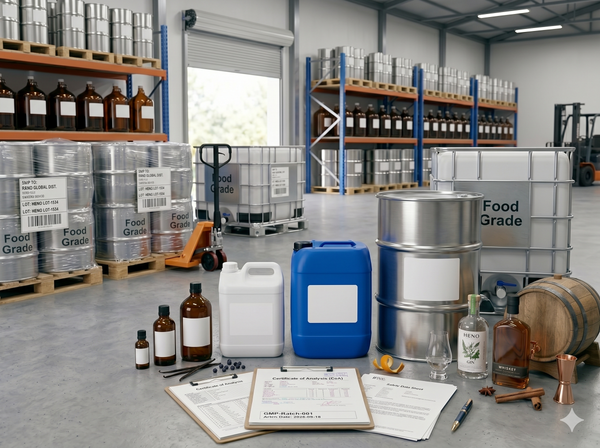
Wholesale hydrosols occupy an odd position in most procurement systems. They are ordered like an essential oil, costed like a fragrance, and specified like nothing at all. The result is a category where two drums carrying the same product name can be genuinely different materials, and nothing on the purchase order would catch it. At HBNO we distill and supply sixteen hydrosols, and the questions we field are rarely the ones that decide whether a batch will work. This guide covers what a hydrosol is on a chromatogram, how a distillate differs from a reconstituted floral water, and the specification lines that belong on a bulk order.
What Wholesale Hydrosols Actually Are
A hydrosol is the aqueous co-product of steam distillation, and its composition is not a diluted version of the essential oil from the same still. The two materials separate by water solubility, not by strength. A single still charge yields both: whatever partitions into the condensate stays in the hydrosol, and whatever partitions into the oil layer becomes the essential oil. That is why a lavender hydrosol and our organic lavender essential oil are co-products rather than a concentrate and its dilution, and it explains almost every surprise a buyer runs into.
Our organic rose floral water makes the point. Distilled in Bulgaria from Rosa damascena petals, its dissolved aromatic fraction runs to roughly 55 percent phenylethyl alcohol against a range of 45 to 63 percent, with citronellol at a typical 15 percent, linalool around 5 percent, and nerol around 4 percent. Rose otto from the same botanical is dominated instead by citronellol and geraniol, because phenylethyl alcohol is water-soluble enough to stay behind. A buyer expecting a rose hydrosol to smell like a thin rose otto is expecting the wrong material. Under INCI conventions the product is declared as Rosa Damascena Flower Water, the name that must appear on a finished-product label regardless of what the purchase order called it.

Distillate or Reconstituted: The Question Most Buyers Skip
"Floral water" and "hydrosol" are used interchangeably in the market, but one can be a genuine distillate and the other can be water with an essential oil solubilised into it. A reconstituted floral water is built rather than distilled: deionised water, a solubiliser, a dose of essential oil, and usually a preservative such as phenoxyethanol. It is legitimate for some applications and far cheaper. It is not what most clean-beauty briefs mean by a hydrosol, and a brand that discovers the difference after a label has been printed has an expensive problem.
Three lines separate them on paper. First, extraction method: a true hydrosol names steam distillation and a plant part on the CoA. Second, refractive index. HBNO specifies 1.325 to 1.340 for our rose hydrosol, essentially that of water, with a specific gravity of 0.980 to 1.100 and optical rotation of minus 1 to plus 1 degrees. A material carrying solubiliser and preservative load will not sit there. Third, ask in writing whether anything was added after the still. Our QC team GC/MS-tests hydrosols the same way we test oils, using the process in our note on how we verify every batch.
The Specifications That Belong on a Bulk Hydrosol Order
An aqueous material carries obligations that an anhydrous essential oil does not, and most hydrosol purchase orders are written as though it does not. Five lines matter more than price:
-
Botanical, plant part, and extraction method, with the INCI name stated. "Rose water" is not a specification; Rosa Damascena Flower Water, steam distilled from petals, is.
-
A microbiological specification with the batch result. An aqueous material has a water activity an anhydrous oil does not, so total aerobic count plus yeast and mould belong on the CoA. That is a quality control parameter, not a product property, and the preservative system in the finished formula stays the formulator's own decision.
-
Packaging material. Our rose hydrosol is specified for glass or PET, not the aluminium drums that suit essential oils. One packaging standard does not cover both categories.
-
Shelf life and storage. Two years at 15 to 25 degrees Celsius. Aqueous materials are less forgiving of a hot warehouse than oils.
-
Certification scope, confirmed per SKU rather than company-wide. Our organic rose floral water is USDA Organic certified through OneCert and Kosher certified through EarthKosher, and our guide to USDA Organic certification for wholesale buyers covers what that reaches downstream.
Cosmetic ingredients are not preapproved before market by the FDA, which puts substantiation and safety documentation on the manufacturer rather than the regulator.
How to Put a Hydrosol Into a Formula Without Reworking It
A hydrosol is water-phase ready, which means it displaces water in a formula rather than adding a phase to it. A mist, toner, or emulsion already carrying deionised water can carry a hydrosol in part or in full without a reformulation, because viscosity, pH behaviour, and phase structure barely move. Cost it against the water it replaces, not the essential oil it came from, and the economics look completely different.
Two cautions follow. Hydrosols carry a real but modest aromatic load, so a formulator expecting essential-oil-level scent throw from a full water-phase substitution should budget fragrance separately. And because the material is aqueous, the finished formula still needs its own preservative system designed by the formulator. Our range spans rose, lavender, neroli, chamomile, calendula, cucumber, frankincense, jasmine, lemongrass, peppermint, rosemary verbenone, tea tree, and ylang ylang, and the grade questions that apply to the oils apply here too. Our note on ylang ylang grades covers how fraction changes what arrives.

How HBNO Supplies Wholesale Hydrosols
We manufacture from a 100,000 square foot facility in Chico, California, with in-house PhD staff and GC/MS testing on every product we ship. Company certifications cover ISO, GMP, FDA, Kosher, USDA Organic, and FAIR FOR LIFE, with product-level certification confirmed per SKU rather than assumed. A batch-specific Certificate of Analysis and Safety Data Sheet ship with every order. We hold no minimum order quantity, which matters in a category where most suppliers start at a 25 kg drum and a formulator wants a litre to trial. Private label capacity runs to 250,000 units per day across mist and toner lines built on our own hydrosols, filled through our private label programme.
Frequently Asked Questions
What is the difference between a wholesale hydrosol and a floral water?
The terms are used interchangeably, which is the problem. A true hydrosol is the aqueous condensate collected from steam distillation of plant material. A reconstituted floral water is assembled afterwards from water, a solubiliser, essential oil, and usually a preservative. The CoA is the only reliable separator: extraction method, refractive index near that of water, and a written statement of whether anything was added after distillation.
Why does rose hydrosol have a different aromatic profile than rose essential oil?
Because the two separate by water solubility rather than by concentration. Phenylethyl alcohol is water-soluble and partitions into the condensate, so it dominates the dissolved aromatic fraction of our rose hydrosol at a typical 55 percent against a 45 to 63 percent range. Rose otto from the same distillation is dominated instead by citronellol and geraniol. Neither is a diluted version of the other.
Which specifications should appear on a hydrosol Certificate of Analysis?
Botanical and INCI name, plant part, extraction method, origin, refractive index, specific gravity, optical rotation, a GC/MS profile of the dissolved aromatic fraction, and a microbiological result covering total aerobic count with yeast and mould, alongside shelf life, storage temperature, and packaging material. A CoA missing the microbiological line is incomplete for an aqueous ingredient.
How should bulk hydrosols be packaged and stored?
In glass or PET, which is what our rose hydrosol is specified for, rather than the lined aluminium drums used for essential oils. Storage runs at 15 to 25 degrees Celsius with a two-year shelf life from the batch date. Warehousing acceptable for oils is often too warm here, so confirm the condition before a container is booked.
Can a hydrosol replace part of the water phase in an existing formula?
In most cases yes, and that is the strongest commercial argument for the category. Because a hydrosol is overwhelmingly water, substituting it for the deionised water in a mist, toner, or emulsion leaves viscosity and phase structure largely unchanged. Two things still need attention: the preservative system remains the formulator's own, and the aromatic load is modest, so scent should be budgeted separately.
Buying the Category Properly
Wholesale hydrosols reward specification and punish assumption. Name the botanical and the INCI declaration, insist on steam distillation stated on the CoA, ask in writing whether anything was added after the still, and require a microbiological result with the batch. Do that, and a category most buyers treat as scented water becomes a predictable water-phase ingredient. For specifications or a quote, contact the HBNO team.
Published by the HBNO editorial team. HBNO (IL Health & Beauty Natural Oils Co., Inc.) is a manufacturer and bulk supplier of essential oils and carrier oils based in Chico, California.