Most purchase orders for avocado oil name the material and stop there. That is where the problem starts, because cosmetic grade avocado oil and cooking grade avocado oil are not two names for one commodity. They are two specifications, two documentation packages, and often two different lots off the same press. A buyer who assumes the grade travels with the botanical name ends up with a green oil in a white lotion, or a cosmetic lot with no food-safety paperwork behind it. At HBNO we supply avocado oil into both channels, and the questions that separate a smooth qualification from a rejected delivery are always the same three: what was refined out, what the certificate of analysis actually reports, and which regulatory file the lot was made against.
What Separates Cooking-Grade From Cosmetic-Grade Avocado Oil
The grade is a refining state plus a documentation package, not a different plant.
Avocado oil (Persea gratissima) is pressed from the fruit pulp rather than a seed, which is unusual among carrier oils and is why the crude oil comes out deep green. From there the paths diverge. Refined avocado oil goes through degumming, neutralisation, bleaching, and deodorising, which strips free fatty acids, the chlorophyll colour, and most of the odour, leaving a pale yellow, near neutral oil. Unrefined or extra virgin material skips those steps and keeps the green colour, the fruity odour, and a higher free fatty acid load.
The numbers make the split concrete. Refined avocado oil is typically specified at 0.5 percent or less free fatty acid expressed as oleic acid, while unrefined grades commonly sit at up to 1.5 percent. Peroxide value tracks the same way: one survey of avocado oil sold in the United States measured refined samples averaging 3.42 milliequivalents of oxygen per kilogram against 7.4 for extra virgin samples (Source: Food Control, 2020). Neither figure is a quality verdict on its own. They are the parameters your incoming specification has to name, because a lotion base and a salad dressing tolerate very different starting points.

The Documentation That Changes Between the Two Grades
Two lots with identical chromatograms can still be the wrong grade, because the difference is carried by the paperwork.
A cosmetic-grade order should arrive with the INCI name, a batch certificate of analysis reporting free fatty acid, peroxide value, colour, and refractive index, a heavy metals result, a microbiological result where the buyer's own specification calls for one, and a current SDS. Our guide to reading every section of a safety data sheet covers what each block is actually for.
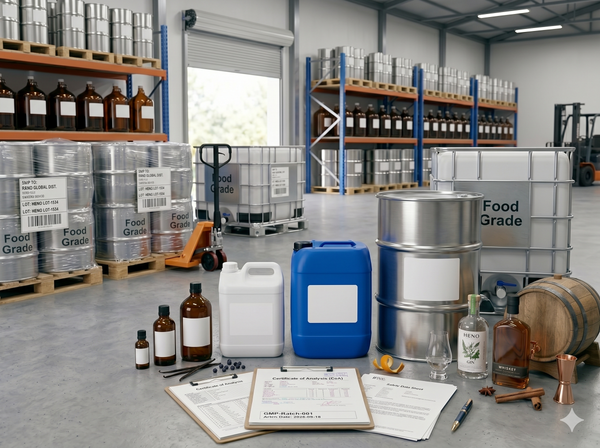
A food-channel order carries a different file. It should reference production in a facility registered with the U.S. Food and Drug Administration, a food-safety program behind the lot, an allergen statement, country of origin, and where the buyer's customers require it, a kosher letter. Our breakdown of what kosher food certification means for ingredient buyers explains what that letter does and does not cover. The practical rule is simple: do not assume a lot released against a cosmetic specification can be re-released into a food application after the fact. Ask which file it was made against before the container ships.
Where Bulk Avocado Oil Buyers Get It Wrong
The most expensive mistake is buying on the words "avocado oil" and assuming grade, colour, and stability come with them.
Three failure patterns repeat. The first is colour. Buyers who specify avocado oil for a pale cream or a white-label lotion and receive an unrefined green lot cannot use it, and the lot is not defective. The second is oxidative state. Unrefined material starts life with a higher peroxide value, so it has less headroom in a warehouse and less headroom again once it sits in a finished emulsion. The third is authenticity. Published analytical work on avocado oil sold in the United States found a meaningful share of samples labelled extra virgin were either oxidised beyond the proposed limits or diluted with cheaper oils, and the analytical literature on those surveys is indexed on ScienceDirect. The same pattern shows up in other high-value carriers, which is why our reality check on what gets sold as argan oil is worth reading alongside this one. The control in every case is a batch certificate of analysis with real numbers on it, not a specification sheet dated to some earlier lot.

Sourcing Bulk Avocado Oil From HBNO
Grade, documentation, and lot-to-lot consistency are what a carrier oil program is actually buying.
HBNO manufactures from a 100,000 square foot facility in Chico, California, holding ISO, GMP, FDA, Kosher, USDA Organic, and FAIR FOR LIFE certifications at company level, with PhD staff and in-house QC. We supply refined avocado oil in bulk, and our product record lists it across personal care, cosmetics, soap, lip balm, and hair care alongside cooking oil, bakery, dressing, and dietary supplement applications, which is exactly why the grade and the file behind a given lot need to be confirmed at order rather than assumed. Refined sesame seed oil sits in the same dual-channel position and is worth quoting alongside it. Every shipment ships with a batch-specific CoA and SDS, and additional batch testing is available on request. There is no minimum order quantity, private label production runs to 250,000 units per day, and drop-shipping and global freight are standard. The wider range sits in our carrier oils collection, and turnkey programs are outlined on our private label page.
Frequently Asked Questions
What does refining actually remove from avocado oil?
Degumming, neutralisation, bleaching, and deodorising remove phospholipids, free fatty acids, chlorophyll and carotenoid pigments, and most volatile odour compounds. The result is a pale yellow, near neutral oil rather than the deep green, fruity crude. The triglyceride backbone is largely unchanged, which is why refined and unrefined lots can look similar on a fatty acid profile and completely different in a finished product.
Which grade should a cosmetic formulator specify?
Refined material is the default for anything where colour and odour matter, which covers most lotions, creams, lip balms, and hair products. Unrefined is specified when the green colour or the fruity note is part of the product story and the formulator has accounted for the shorter oxidative headroom. Either way the specification should name free fatty acid and peroxide value limits rather than just the word "refined".
Can the same lot of avocado oil be used for food and cosmetics?
Not automatically. The physical oil may be suitable for both, but release for a food application depends on the facility registration, the food-safety program, and the documentation the lot was produced and released against. Confirm which file the lot was made to before ordering rather than trying to reclassify it afterwards.
How should bulk avocado oil be stored to protect its specification?
Keep it cool, sealed, and out of direct light, and minimise headspace in partially used containers, because oxygen contact is what moves peroxide value. Record the receipt date against the certificate of analysis so the remaining usable life is tracked against a real starting number rather than a nominal shelf life printed on a spec sheet.
Why is unrefined avocado oil usually more expensive than refined?
Unrefined grades demand better fruit, faster processing after harvest, and tighter handling to hold the low free fatty acid and peroxide figures that justify the label. Refined material is more tolerant of variable feedstock because the refining steps remove the defects, so it is generally cheaper and more consistent from lot to lot.
HBNO's Food Grade Essential Oils are concentrated ingredients listed by the U.S. Food and Drug Administration ("FDA") as "Generally Recognized as Safe." These ingredients can be used in food applications according to guidelines set forth by the FDA and the Flavor and Extract Manufacturers Association. For commercial use, please consult industry guidelines, such as FEMA, for information related to the safe use of these concentrated ingredients.
Published by the HBNO editorial team. HBNO (IL Health & Beauty Natural Oils Co., Inc.) is a manufacturer and bulk supplier of essential oils and carrier oils based in Chico, California.
Specifying cosmetic grade avocado oil correctly takes three lines on a purchase order: the refining state, the free fatty acid and peroxide limits, and the regulatory file the lot must be released against. Get those on paper and the colour surprises, the shelf-life arguments, and the re-qualification delays mostly disappear. To request current specifications, a batch CoA, or wholesale pricing on refined or organic avocado oil, contact the HBNO team.