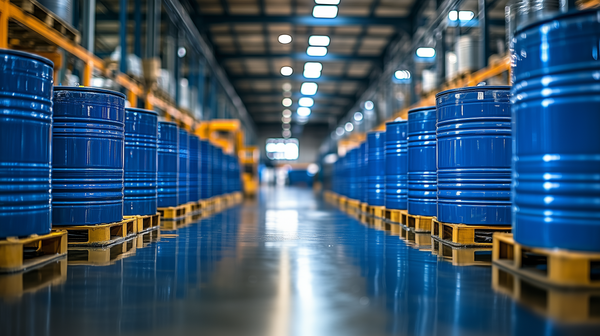
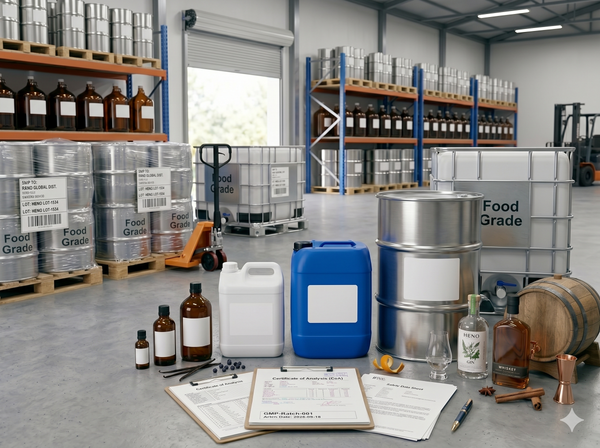
Witch hazel is one of the few personal care raw materials bought in genuinely large water-phase volumes, and that changes how it should be procured. A brand ordering essential oil buys kilos. A brand ordering bulk witch hazel buys barrels and totes, which means freight, storage footprint and water weight enter the calculation alongside price per litre. It also means specification drift has a bigger effect: a difference in alcohol content or extract strength that would be trivial at 1 percent inclusion becomes a formulation-wide variable when the material is 40 percent of the batch. Here are the eight reasons brands commit to barrel volume, and what to fix in the specification before they do.
What "witch hazel" actually means on a purchase order
The term covers several materially different products, and the two that matter commercially are the steam distillate and the concentrated extract.
The distillate is produced by steam distilling Hamamelis virginiana bark and twigs, and it is a dilute aqueous material typically stabilised with alcohol. Most commercial witch hazel sold in volume is this. A concentrated extract is a different product with a much higher solids content, intended for dilution rather than direct use. Ordering one when your formula assumed the other will change your entire water phase.
Alcohol content is the second axis, and it is where most specification disputes originate. Traditional distillates carry a meaningful alcohol fraction as a stabiliser. Alcohol-reduced and alcohol-free versions exist and behave differently in a formulation, on skin feel, and in terms of what preservation the finished product needs. Write the alcohol figure into the specification as a number, not as a description, because "low alcohol" is not a specification.

Eight reasons brands commit to barrel volume
The case for barrel purchasing is mostly economic rather than technical, and it rests on the material's position as a high-inclusion water-phase component.
-
Inclusion rate. In toners and facial mists it commonly runs 30 to 70 percent of the formula, so annual consumption reaches barrel scale quickly even at modest unit volumes.
-
Freight economics. Witch hazel is mostly water, and water is heavy. Shipping it in small containers means paying repeatedly to move the same water. Consolidating into barrels or totes is where the landed cost saving actually sits.
-
Batch consistency across a range. Brands using it in four or five SKUs benefit from one qualified lot across all of them rather than reconciling several.
-
Water-phase cost displacement. It substitutes for part of the deionised water in a formula while contributing to the ingredient list, which changes the cost-per-unit arithmetic favourably.
-
Label recognition. Consumers know the ingredient. That recognition has commercial value on a front-of-pack ingredient callout.
-
Formulation simplicity. It arrives as an aqueous material, so it incorporates into a water phase without the emulsification work an oil requires.
-
Multi-format use. The same material serves toners, mists, wipes and cleansers, so one purchase supports several product formats.
-
Reorder predictability. High-inclusion materials generate stable, forecastable demand, which is exactly the profile that earns volume pricing from a supplier.
The specifications worth pinning down
Five numbers should appear on a bulk witch hazel specification: alcohol content, tannin or solids content, pH, appearance, and microbiological limits.
Alcohol content drives skin feel, preservation burden and, at higher levels, transport classification. Tannin or total solids content is the closest available proxy for extract strength, and it is the figure that varies most between suppliers presenting nominally identical material. pH matters because a water-phase component at 40 percent inclusion will move the pH of the finished product, and a formulation balanced against one lot can drift with the next.
Microbiological limits deserve attention precisely because this is a water-based material. Aqueous raw materials require different handling from oils, and the preservation strategy for the finished product remains the formulator's own determination. At HBNO we supply an organic witch hazel, and because documentation varies by material and lot for aqueous products, confirm the certification and analytical documentation for the specific lot at the time of order rather than assuming the profile of our essential oil range. Our guide to essential oil certifications explains why that distinction matters, and the product list shows the current form.
Freight, storage and the water-weight problem
The largest hidden cost in bulk witch hazel is not the material, it is moving and storing several hundred kilos of water.
Three practical consequences follow. First, freight class and pallet configuration matter more than a small difference in price per litre; run the landed-cost comparison, not the unit-price comparison. Second, storage temperature matters for an aqueous material in a way it does not for a stable carrier oil, and a warm warehouse is a microbiological risk rather than merely an oxidative one. Third, decanting discipline is important: repeatedly opening a barrel in an uncontrolled area introduces contamination risk that a sealed drum of oil simply does not carry.
Brands scaling into this material often underestimate the floor space. A tote is not a shelf item. Handling conventions from the Personal Care Products Council are a reasonable starting reference, and Grand View Research records continued growth in naturally derived personal care ingredients, part of why barrel-scale purchasing has become common.

Sourcing bulk witch hazel and adjacent materials from HBNO
We manufacture from a 100,000 square foot facility in Chico, California, operating under ISO and GMP systems with FDA registration, with PhD staff and in-house quality control. Alongside witch hazel we supply the aqueous and aromatic materials that usually sit beside it in a toner or mist formulation, including organic floral waters and hydrosols and the wider essential oils range.
Two operational points help a brand entering this category. There is no minimum order quantity, so a formulation can be qualified at small scale before committing to barrel volume and the storage that comes with it. And our private label operation fills to 250,000 units per day with drop-shipping available, which is often the better answer for a water-phase product than building the handling capability in house. Our guide to sourcing frankincense oil for skincare brands covers the aromatic side of the same formulations.
Frequently asked questions about bulk witch hazel
Which witch hazel form should a barrel-scale buyer order?
The distillate is a dilute aqueous material produced by steam distillation and usually stabilised with alcohol, and it is what most volume buyers use directly. An extract has a much higher solids content and is intended for dilution. They are not interchangeable, and substituting one for the other changes the entire water phase of a formula.
Why does alcohol content matter so much in a witch hazel specification?
Because at 30 to 70 percent inclusion the alcohol fraction affects skin feel, the preservation burden on the finished product, and potentially the transport classification of the raw material. Specify it as a numeric range. Descriptive terms such as low alcohol carry no defined meaning between suppliers.
How should a barrel of witch hazel be stored?
Cool, sealed, and in a controlled area, with decanting done under conditions appropriate to an aqueous raw material. Because there is free water available, the risks are microbiological rather than oxidative, which is the opposite of how a carrier oil behaves. Minimise the number of times the container is opened.
Does witch hazel change the pH of a finished formula?
At high inclusion rates it usually does. Since it can constitute the majority of a water phase, its own pH substantially influences the finished product, so a formula balanced against one lot may need adjustment with another. Include pH in the specification and check it on intake.
What inclusion rate do toners and mists typically use?
Commonly 30 to 70 percent of the formula, which is why annual consumption reaches barrel scale even for brands with modest unit volumes. The exact rate depends on the rest of the water phase and on the sensory target, and it should be set on bench work rather than adopted from a published formula.
Getting the bulk witch hazel specification right before you commit to a barrel
Witch hazel rewards volume buyers and punishes vague specifications, because at 40 percent inclusion nothing about the material stays a minor detail. Establish whether you are buying distillate or extract, put the alcohol content and tannin figure in writing, include pH and microbiological limits, and run the landed-cost comparison rather than the price-per-litre one. Then confirm the documentation available for the specific lot before it ships. To review current form, specification and availability of bulk witch hazel, contact our team for a quote.
Published by the HBNO editorial team. HBNO (IL Health & Beauty Natural Oils Co., Inc.) is a manufacturer and bulk supplier of essential oils and carrier oils based in Chico, California.