For procurement teams sourcing from our essential oils collection into a warehouse, a formulation lab, or a private label production line, the paperwork that arrives with the drum matters almost as much as the oil inside it. Buyers ask what is an SDS so often because the document gets confused with a Certificate of Analysis, treated as optional, or filed away unread. It is none of those things. A Safety Data Sheet is a standardized, GHS-format hazard communication document, and understanding what it covers, why it exists, and why HBNO issues one with every shipment is basic due diligence for any buyer handling concentrated aromatic materials at volume.
What Is an SDS and Why Does It Exist?
A Safety Data Sheet (SDS) is the standardized, 16-section document that communicates a material's hazards, safe handling requirements, and emergency response information from supplier to buyer. It exists because concentrated essential oils, even when derived from a garden herb or a citrus peel, carry real physical and health hazards at industrial volume: skin sensitization potential, flammability, and reactivity with strong oxidizers among them. Before a harmonized format existed, this information was communicated inconsistently, if at all, in a document called a Material Safety Data Sheet, or MSDS. The current SDS format was adopted when regulators aligned domestic hazard communication rules with the United Nations' Globally Harmonized System of Classification and Labelling of Chemicals, so every SDS a buyer receives today follows the same 16-section order regardless of which supplier issued it. The result is that a procurement manager comparing suppliers can find hazard classification, storage requirements, or first aid guidance in the same place every time.

Why Bulk Essential Oil Buyers Need an SDS on File
Buyers need a current SDS on file because it is the document that supports safe warehousing, downstream employee training, and import compliance, not a formality attached to the invoice. A distributor is required to pass an accurate, current SDS to every downstream buyer of a hazardous material, and an employer receiving that material has a parallel obligation to make it available to any employee who handles it. Consider lavender essential oil: its SDS documents a flash point of 75 degrees Celsius, skin sensitization potential, and incompatibility with strong oxidizing agents and mineral acids, all of which shape how a warehouse stores and rotates the drum. Peppermint essential oil carries a higher flash point near 91 degrees Celsius but the same sensitization notation, a detail a formulator needs before setting a leave-on usage rate. Neither fact appears on a Certificate of Analysis. A buyer who only requests a CoA is missing the half of the documentation package that governs how the material is actually handled once it is on site.
SDS vs CoA: Two Different Documents Buyers Often Confuse
An SDS and a Certificate of Analysis answer two different questions, and neither substitutes for the other. A CoA is batch-specific: it confirms the GC/MS constituent profile, specific gravity, and refractive index of the lot in front of you, and it changes every time a new batch is tested. For buyers who want to interpret that constituent data line by line, our companion on reading a GC-MS analysis report walks through retention time, peak percentages, and marker compounds. An SDS is hazard-specific and comparatively static: it changes only when the material's hazard classification, a regulation, or a manufacturing process genuinely changes, and it is meant to travel with every batch of that product regardless of which harvest it came from. Buyers formulating for the European Economic Area will recognize the same 16-section logic from REACH's own safety data sheet requirement, which runs in parallel with the GHS format used domestically. The International Fragrance Association publishes separate usage and dilution standards that formulators should read alongside the SDS, not instead of it, since IFRA governs finished-product usage rates while the SDS governs the raw material's hazard profile. A buyer who understands this distinction stops asking a supplier for "the safety papers" and starts requesting the specific document that answers their actual question, whether that is composition, hazard, or formulation limits. For a full walk-through of what each of the SDS's 16 sections actually contains, see to reading every section of a safety data sheet.
How HBNO Documents Every Shipment
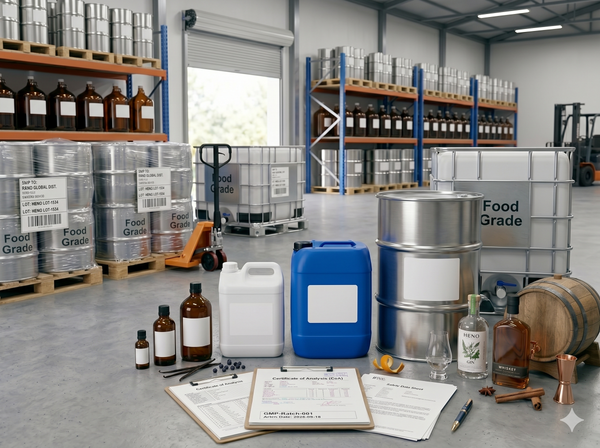
At HBNO, a Certificate of Analysis and a Safety Data Sheet accompany every shipment as standard practice, not an add-on a buyer has to request separately. Our facility in Chico, California runs GC-MS testing on every batch, and additional batch-specific testing is available on request for buyers who need it beyond the standard CoA. HBNO holds ISO, GMP, FDA registration, Kosher, USDA Organic, and FAIR FOR LIFE certifications at the company level, as detailed on our About Us page, and our in-house quality control team, which includes PhD staff, maintains the documentation that supports both the CoA and the SDS for every SKU we ship. There is no minimum order quantity, and we ship globally across North America, Europe, Asia, and Oceania, which means the SDS package has to hold up under REACH, IFRA, and GRAS expectations in more than one jurisdiction at once. If your MSDS to SDS transition history is the part you actually need explained, read our companion piece on what changed when MSDS became SDS.

What Should a Buyer Confirm Before Placing a Bulk Order?
Before committing to a volume order, confirm that the supplier can produce a current SDS for the exact product and grade you are buying, not a generic template for the botanical family. Check the revision date, confirm the document reflects the GHS-aligned 16-section format, and verify it names the correct supplier and emergency contact. A supplier that hesitates to produce this before an order is placed is telling a procurement manager something worth hearing.
Frequently Asked Questions
What does SDS stand for, and how is it different from an MSDS?
SDS stands for Safety Data Sheet. An MSDS, or Material Safety Data Sheet, was the predecessor document used before hazard communication rules were aligned with the UN's Globally Harmonized System. The two cover similar ground, but the SDS follows a mandatory 16-section order while the older MSDS format varied by manufacturer with no required structure.
Why do I need an SDS if I already have a Certificate of Analysis?
A CoA confirms the chemistry and purity of a specific batch through GC/MS and physical testing. An SDS documents the material's hazard classification, storage requirements, and emergency response information, none of which a CoA covers. Buyers who store, blend, or ship the material need both documents on file, not one in place of the other.
How often does HBNO update the SDS for a product?
An SDS is updated when a material's hazard classification changes, when a regulation the document must reflect changes, or when new toxicological or physical data becomes available, not on a fixed calendar. HBNO's quality control team reviews SDS content as part of its ongoing documentation process for every SKU in the catalog.
Can I request an SDS before placing an order?
Yes. A supplier should be able to produce the current SDS for a specific product on request, before a purchase order is issued, so that a buyer's safety and procurement teams can review it in advance. HBNO provides SDS and CoA documentation to buyers evaluating a product ahead of a volume commitment.
Is an SDS required for every country HBNO ships to?
Requirements vary by jurisdiction, but the GHS framework that the SDS format follows has been adopted widely enough that the same 16-section document supports compliance in most of the regions HBNO ships to, including North America, Europe, Asia, and Oceania. Buyers importing into a specific country should confirm any local labeling or language requirements with their own compliance team.
Understanding what an SDS is, and why it is distinct from a CoA, is the first step toward reading one correctly once it lands on your desk. Every shipment leaving HBNO's Chico, California facility ships with both documents as standard practice, so buyers evaluating a bulk essential oil supplier are never asking a supplier to produce paperwork after the fact. If your team needs a current SDS ahead of a volume order, contact HBNO directly.
Published by the HBNO editorial team. HBNO (IL Health & Beauty Natural Oils Co., Inc.) is a manufacturer and bulk supplier of essential oils and carrier oils based in Chico, California.