Procurement teams sourcing essential oils in volume run into the same line on nearly every supplier one-sheet: "FDA registered." Few buyers stop to confirm what that phrase actually covers, and the gap between assumption and fact creates real supply chain risk. An FDA registered essential oil manufacturer has completed a specific facility-level filing under a specific federal framework. It has not received a government stamp of approval on its products, and it cannot legally claim one. For a procurement manager building a supplier scorecard, or a formulator vetting a new source ahead of a production run, knowing what FDA registration means, what it does not cover, and how to verify it is the difference between a defensible compliance file and a claim taken on faith. At HBNO, new accounts ask us to explain this distinction often enough that it is worth setting out plainly.
What FDA Facility Registration Actually Means
FDA facility registration is a federal filing that identifies a manufacturing site to the agency, not a certification of the products made there. Two separate tracks apply depending on how the material will be sold. A facility making food-grade or flavor-use material registers as a food facility under the Food Safety Modernization Act, a filing tied to Section 415 of the Food, Drug, and Cosmetic Act and renewed during a set window in every even-numbered year. A facility making cosmetic-grade material registers under the Modernization of Cosmetics Regulation Act, which also requires listing the cosmetic products marketed from that site and renewing the registration every two years. A manufacturer that supplies both food-grade and cosmetic-grade essential oils may need to maintain both filings at once, one per applicable category.
Registration is self-reported: the manufacturer submits its own facility details, and the filing itself does not involve FDA inspecting and signing off on a formula before that filing is accepted. Inspections happen separately, on the agency's own risk-based schedule. That is precisely why "registered" and "approved" describe two different things, and conflating them is the single most common misstatement in essential oil sourcing conversations.

What FDA Registration Does Not Cover
Registration confirms that a facility exists in FDA's system, not that any specific formula, claim, or safety profile has been reviewed and endorsed by the agency. "Registered" and "approved" get conflated often enough that we cover the distinction on its own in Are Essential Oils FDA Approved? What FDA Registration Really Covers. The FDA does not pre-approve cosmetic formulations the way it reviews and approves new drugs. Premarket approval applies only to products the agency classifies as drugs, and that classification turns on the claims made for a product, not the ingredient list behind it. A properly registered raw material can still end up in a finished good that crosses into drug territory at the labeling stage, a review that sits with the brand, not the raw material manufacturer.
Trade groups such as the Personal Care Products Council publish general guidance on cosmetic labeling and substantiation, a useful reference for a brand team assembling that review. See the essential oils skincare brands put front-and-center on the label for how this plays out when an oil is named on the front of a pack.
A Buyer's Due Diligence Checklist for Confirming Registration Status
A verifiable FDA registration claim comes with a document trail, and a buyer should ask for the whole trail before treating the claim as settled. A practical checklist for a supplier qualification file:
-
Ask for the facility's registration number and confirm which track it falls under: food facility registration, cosmetic product facility registration, or both.
-
Confirm the registration actually covers the category of the product being purchased. A cosmetic-only registration does not extend to a food-grade claim on the same site.
-
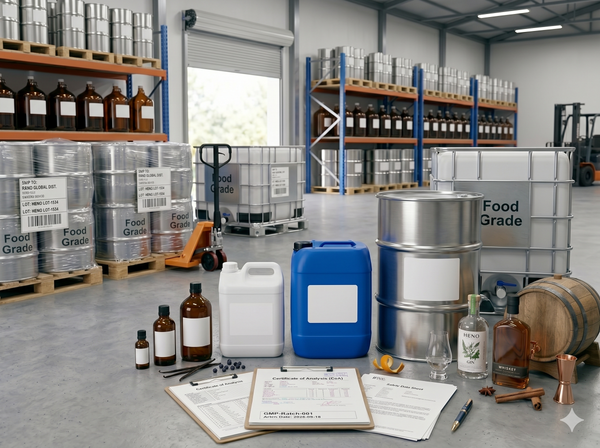
Request a current, lot-specific Certificate of Analysis and Safety Data Sheet rather than a generic template dated years earlier.
-
Ask whether GC/MS testing is performed in-house or through a third-party laboratory, and at what frequency relative to production lots.
-
Confirm that certifications such as USDA Organic, Kosher, or food-grade GRAS status are verified at the individual product level, since none travel automatically to every SKU.
At HBNO, our Lavender Essential Oil and Peppermint Essential Oil both ship from the same FDA-registered Chico, California production site, each with its own lot-specific CoA and SDS. That product-level paper trail, not the general registration claim alone, is what a buyer should expect to see before a purchase order goes out, regardless of which supplier a program uses. For the fuller picture of what to check across a supplier's whole certification stack before placing a bulk order, see our guide to choosing a GMP certified essential oil manufacturer for bulk orders.
Why Registration Status Belongs on Every Supplier Scorecard
A verified registration signals operational maturity even though it says nothing about how a product performs in a finished formulation. Maintaining it requires the recordkeeping, traceability, and recall-readiness infrastructure FDA expects between inspections, a genuine signal of supply continuity and audit readiness. It tells a buyer that a supplier can produce documentation a private label program, a retailer audit, or an import inspection will eventually ask for, though nothing about scent quality, chemical consistency, or price, which is why registration belongs alongside those factors on a scorecard rather than in place of them. We expect that same scrutiny from our own accounts, and we build our documentation to match it.

Where HBNO Fits This Picture
A fully documented registration profile looks like this in practice. HBNO manufactures from a 100,000 square foot production facility in Chico, California that holds FDA registration alongside ISO, GMP, Kosher, USDA Organic, and FAIR FOR LIFE certifications. Every product across our essential oils range carries GC/MS testing, and a Certificate of Analysis and Safety Data Sheet ship with every order. Our in-house team, including PhD-level formulation staff, supports REACH, IFRA, GRAS, and food-safety compliance where those frameworks apply to a given material. There is no minimum order quantity, private label production runs up to 250,000 units per day, drop-shipping is available, and we ship globally. We list these credentials here as facts a buyer can verify, not as a substitute for the due diligence checklist above.
Frequently Asked Questions
What is the difference between FDA registration and FDA approval for essential oils?
Registration is a facility-level filing that puts a manufacturing site into FDA's system under the applicable food or cosmetic framework. Approval is a premarket review the agency reserves for products it classifies as drugs. Essential oils sold as cosmetic or food-grade materials are not eligible for drug approval, so no essential oil, from any manufacturer, is ever accurately described as "FDA approved."
How do I verify a supplier's FDA registration number?
Ask the supplier directly for the registration number and the track it was filed under, then request supporting documentation such as the registration confirmation. A supplier confident in its compliance status will provide this without hesitation as part of a standard qualification file.
Does FDA registration cover every product a manufacturer sells?
No. Registration applies to the facility and the general category of products made there, food or cosmetic, but it does not certify each individual formula. Product-specific claims like USDA Organic or food-grade GRAS status require their own separate confirmation for each SKU.
Is FDA facility registration required for essential oil manufacturers?
It depends on how the material is sold. A facility producing food-grade or flavor-use essential oils generally must register under the Food Safety Modernization Act, while one producing cosmetic-grade material registers under the Modernization of Cosmetics Regulation Act. A facility selling only unregulated industrial materials outside either category may fall outside both requirements.
Should a food-grade essential oil supplier have a different FDA registration than a cosmetic-grade one?
Yes, in practice. Food facility registration and cosmetic product facility registration are separate filings under separate statutes. A manufacturer supplying both categories of material typically maintains both registrations, and a buyer sourcing a food-grade material should confirm the food facility filing specifically rather than accept a cosmetic registration as sufficient.
Confirming registration status is one line item in a much larger supplier qualification process, but it is the one most often taken on faith. An FDA registered essential oil manufacturer has met a real, verifiable federal filing requirement, and asking for the documentation behind that claim costs a buyer nothing beyond one email. Sourcing teams that want that documentation alongside GC/MS data, CoA, and SDS paperwork should expect a facility that has already done this qualification exercise with hundreds of other accounts.
Published by the HBNO editorial team. HBNO (IL Health & Beauty Natural Oils Co., Inc.) is a manufacturer and bulk supplier of essential oils and carrier oils based in Chico, California.
For current FDA registration documentation, CoA, and SDS paperwork on any HBNO oil, reach out to HBNO's team.