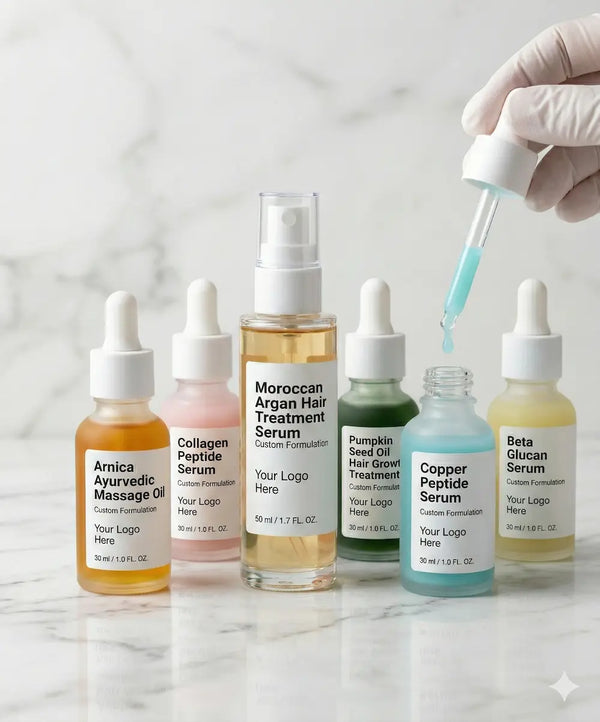
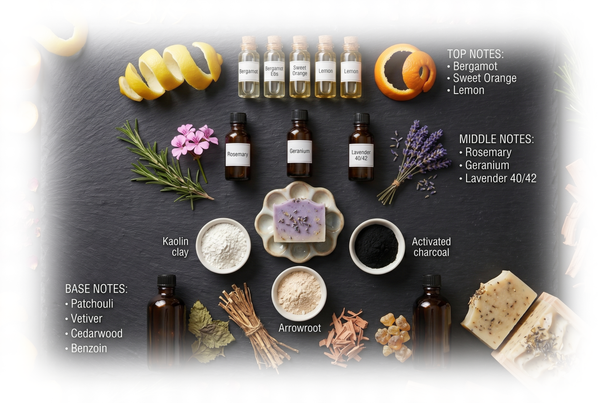
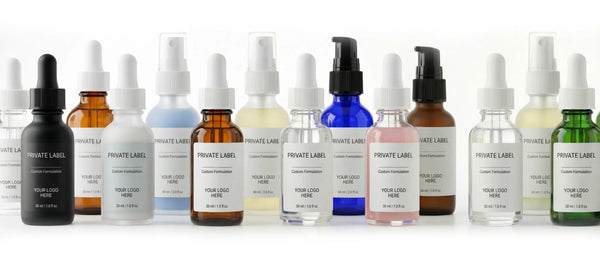
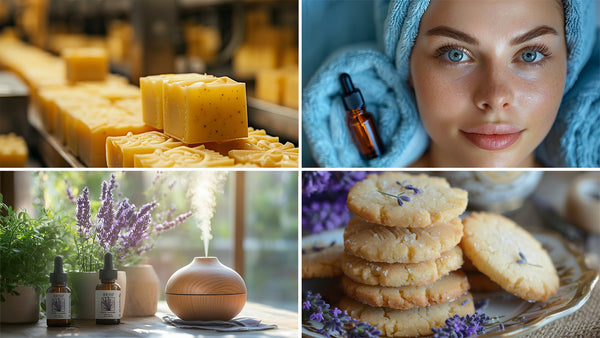
There is a meaningful difference between an essential oil buried at position fourteen on an ingredient list and one printed on the front of the carton. The first is a formulation decision. The second is a marketing commitment, and it changes the procurement requirements attached to the material. A front-of-pack callout invites consumers, retailers and regulators to look closely at what is actually in the bottle, at what concentration, and with what substantiation behind whatever the pack says next to it. Choosing essential oils for skincare products that can carry that scrutiny is a different exercise from choosing ones that merely need to work. Here are the oils brands actually put forward, and what each one demands in return.
Why label prominence changes the sourcing brief
Naming an essential oil on the front of a pack raises three requirements at once: a defensible inclusion rate, allergen declaration accuracy, and claim substantiation for anything printed beside it.
Inclusion rate is the first exposure. A brand that features an oil prominently while including it at 0.05 percent is making an implicit representation about the formulation that a competitor or a regulator can question. There is no fixed legal threshold, but the practical standard is that the material should be present at a level where it plausibly contributes something.
The second is allergen accuracy. Front-of-pack prominence draws attention to the ingredient list, and several of the most marketable essential oils are allergen-dense. Linalool, limonene, geraniol and citral all carry declaration thresholds. The third is claim substantiation, and it is where most of the risk sits. The oil's presence is a fact. What it does is a claim, and the standard of proof for a claim is not met by the oil being popular.

The oils that earn front-of-pack position
Five essential oils dominate front-of-pack callouts in skincare, and each is chosen for recognition value as much as for formulation contribution.
-
Lavender. The most recognised botanical in personal care. Our GC/MS records show linalyl acetate at 27 to 37 percent and linalool at 28 to 35 percent. Available across grades from standardised 40/42 through single-origin and certified organic, and the grade should match the positioning.
-
Tea tree. Strong recognition, and the most claim-constrained oil on this list. Its popular associations are antimicrobial ones, which are precisely the claims that require regulatory registration and which we do not support for any material. Feature the oil, describe the material, and leave the mechanism alone.
-
Frankincense. The premium positioning choice, widely used in facial serum and mature-skin product lines. That category framing is the compliant way to describe it.
-
Chamomile. Long-established in gentle-positioning skincare and in aromatherapy-adjacent products, with a distinctive profile that justifies naming.
-
Rose and rose absolute. The highest cost per kilo by a wide margin, which is why it usually appears at low inclusion. If it is on the front of the pack, be ready to state the percentage.
Carrier oils frequently share front-of-pack space, particularly rosehip, argan and jojoba, and they are usually easier to feature honestly because their inclusion rates are naturally high.
Inclusion rates that hold up to scrutiny
Most leave-on skincare runs total essential oil content between 0.5 and 2 percent, and the ceiling is set by IFRA category limits and allergen thresholds rather than by what the fragrance brief wants.
Leave-on products sit in the most restrictive IFRA standards categories, well below rinse-off allowances, and the limits are material-specific rather than uniform. A blend that is compliant for one oil can breach the limit for another at the same total load. The discipline is to calculate per component, not per blend.
Allergen declaration thresholds trigger separately and lower. In practice a leave-on product at 1 percent aromatic load will often require several declarations, and the declaration list is generated from the GC/MS profile of the specific materials rather than from a generic table. At HBNO every lot is GC/MS tested in house and ships with a CoA and SDS, which is what makes an accurate declaration possible. Cosmetic labelling in the United States follows FDA requirements, and the substantiation burden for any claim rests with the brand. Our essential oils range covers each of the materials above.
What the pack can say, and what it cannot
Describing the material and the product category is compliant. Describing what the oil does to skin is a claim, and most of the popular ones are not available.
The categories to avoid are broader than most brands assume. Anything suggesting a product treats, prevents or improves a named skin condition is a drug claim. Anything asserting antimicrobial action requires registration. Cell-level and structural language, including anti-aging and collagen references, is not available. Nor is "hypoallergenic" or "suitable for sensitive skin", which are effectively guarantees against a reaction.
What is available is genuinely useful: the botanical source, the GC/MS constituent profile, the grade and certification, the extraction method, and the product category the material is formulated into. A pack that says a serum is formulated with organic frankincense for a mature-skin range is making a compliant statement. A pack that says the frankincense reduces wrinkles is not. Our guide to sourcing frankincense oil for skincare brands covers the specification side, and our tea tree oil formulation guide works through the same distinction for that material.

Sourcing label-forward essential oils from HBNO
We manufacture from a 100,000 square foot facility in Chico, California, operating under ISO and GMP systems with FDA registration, with PhD staff and in-house quality control. Certifications including Kosher, USDA Organic and FAIR FOR LIFE are held at company level, and product level certification is confirmed per SKU, which matters when a front-of-pack organic claim depends on a lot-level certificate rather than a supplier-level one.
Two points help a brand building a label-forward range. There is no minimum order quantity, so a premium material can be evaluated at sample scale before a positioning decision is locked. And USDA Organic certified oils are listed separately so the certified options are straightforward to identify. Our private label operation fills to 250,000 units per day if you would rather buy finished units.
Frequently asked questions about essential oils for skincare products
What inclusion rate justifies naming an essential oil on the front of a pack?
There is no fixed legal threshold, but the practical standard is a level at which the material plausibly contributes to the product. For most leave-on skincare that means the oil sits within the normal 0.5 to 2 percent aromatic band rather than at a trace level. Be prepared to state the percentage if asked.
Which essential oils carry the most allergen declarations?
Materials with substantial linalool, limonene, geraniol and citral content generate the most declarations, which includes lavender, citrus oils and lemongrass among others. The declaration list is derived from the GC/MS profile of the specific lot rather than from a generic table, so it should be regenerated when a supplier or grade changes.
Can a skincare pack describe what an essential oil does for skin?
Only within narrow limits. Describing the material, its origin and grade, and the product category it is formulated into is compliant. Describing an effect on skin structure or a named condition is a claim requiring substantiation, and several popular framings are not available at all. Take those decisions with your own regulatory advisers.
Does a front-of-pack organic claim require anything beyond an organic oil?
Yes. It requires a certificate traceable to the specific lot used in the batch, not a supplier-level certificate. Organic status is confirmed per SKU rather than inferred across a catalogue, and the documentation chain has to hold from the grower through to the finished good.
How do IFRA limits interact with a multi-oil blend?
They apply per component, not to the blend as a whole. A total aromatic load that is comfortable for one material may exceed the limit for another within the same blend. Calculate each component against its own limit for the intended product category, and recheck whenever the standards are amended.
Choosing essential oils for skincare products you intend to name
Front-of-pack prominence is worth having, and it costs more than shelf space. It commits a brand to an inclusion rate it can defend, an allergen declaration generated from real lot data, and a claim discipline that keeps the copy on the material rather than on its effects. Choose oils whose recognition value survives that scrutiny, specify them per SKU with lot-level certification, and calculate IFRA compliance component by component. To review specifications or request samples of any label-forward essential oil, contact our team for a quote.
Published by the HBNO editorial team. HBNO (IL Health & Beauty Natural Oils Co., Inc.) is a manufacturer and bulk supplier of essential oils and carrier oils based in Chico, California.