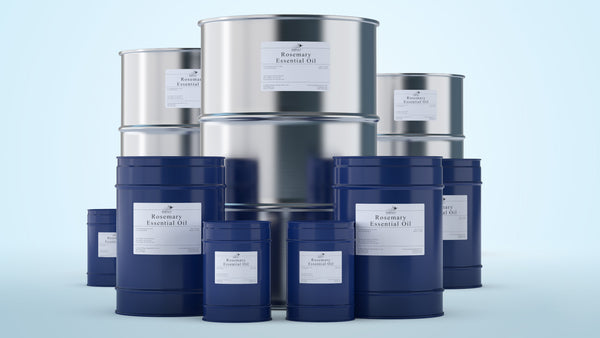
The global personal care market continues to expand (Grand View Research), with oil-based formulations among the fastest-growing product categories across facial serums, body oils, hair oils, and scalp treatments. For brands entering the private label essential oils and cosmetics space, oil-centric SKUs offer a compelling structural advantage: lower formulation complexity, faster regulatory clearance, and a supply chain anchored to two or three core raw materials. Getting that supply chain right from formulation brief to qualified supplier to scaled production is where most new private-label cosmetics brands lose time and margin.
Why Private-Label Essential Oils Are the Most Scalable Starting Point for a Cosmetics Range
Oil-based formulations offer the fastest path from concept to market for private-label cosmetics brands because they carry lower regulatory complexity and simpler ingredient disclosure requirements than emulsion-based products.
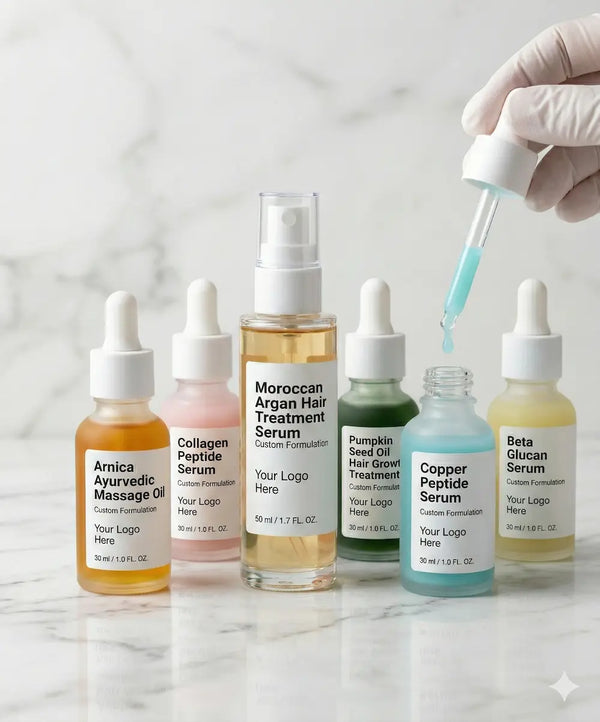
A face serum, body oil, or hair oil typically involves two to five raw ingredients: a carrier oil base, an essential oil or fragrance component, and optionally a tocopherol antioxidant for shelf stability. Compared to an emulsion which requires an emulsifier, preservative system, pH buffer, and water-phase management oil formulations can be stability-tested and approved for production in weeks rather than months.
Under FDA cosmetic regulations, oil-based products classified as cosmetics require ingredient disclosure under the INCI naming convention and net quantity labelling, with no pre-market approval required. This makes private-label essential oils and oil-based SKUs the most accessible high-margin entry point for brands building a personal care range from the ground up.

Writing a Formulation Brief for Private-Label Oil-Based Cosmetics
A formulation brief translates a product concept into a purchasable specification without one, every supplier conversation restarts from scratch.
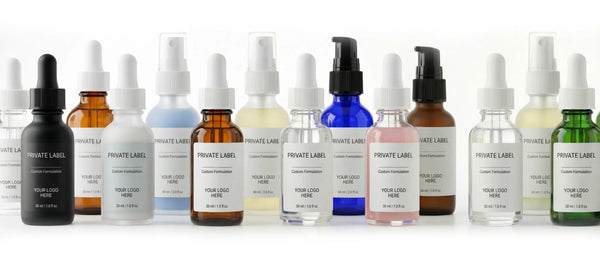
A complete brief for an oil-based cosmetic includes: carrier oil base and percentage, essential oil or fragrance component and load rate, target application (face, body, hair, scalp), packaging format (dropper bottle, pump, roller), claimed shelf life, and certification tier (conventional, USDA Organic, vegan). Include market-specific regulatory requirements REACH substance-level documentation for EU distribution, allergen labelling thresholds under IFRA guidelines for UK and EU markets, and organic certification traceability for US retail channels.
Sharing this brief with suppliers at first contact shortens sample turnaround from weeks to days and ensures the CoA and GC/MS documentation you receive matches the formulation you plan to scale. It also prevents grade mismatches a supplier delivering refined carrier oil when your brief specifies unrefined is a quality event, not a negotiation.
Qualifying an Oil Supplier for Private-Label Cosmetics Production
The right oil supplier for a private-label cosmetics brand is not the lowest unit price it is the supplier whose documentation infrastructure supports your finished product audit trail.
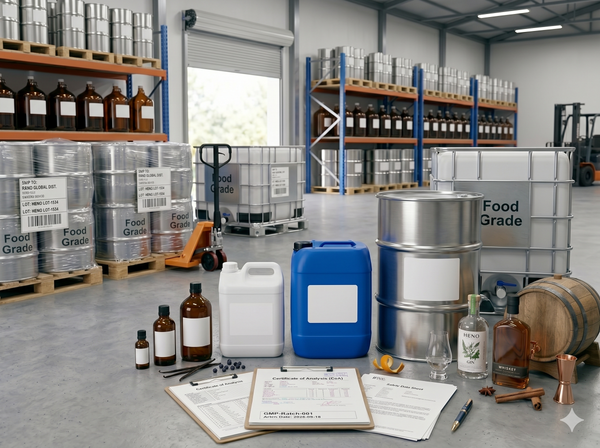
Four criteria define a qualified cosmetics-grade oil supplier. GMP certification under ISO 22716 confirms manufacturing controls meet cosmetic industry standards and supports your own finished product compliance. Batch-level GC/MS documentation for every essential oil confirms compositional integrity across production runs spot-check testing alone is not sufficient for production-scale qualification. FDA registration for US-market supply indicates the facility operates within regulated cosmetic manufacturing parameters. No-minimum sample access allows stability and compatibility testing before any volume commitment.
At HBNO, we supply ISO, GMP, and FDA-registered essential oils and carrier oils with full batch documentation CoA, SDS, GC/MS report, and IFRA conformance certificate on every order, at any volume.
Scaling from Sample Batch to Full Production: The Oil Procurement Roadmap
Private-label cosmetics brands that scale without supply disruptions follow a four-stage oil procurement model: sample qualification, stability testing, trial production, and contracted supply.
Stage one is sample qualification: order the smallest available volume of each oil with full documentation, confirm GC/MS data matches your formulation specification, and run organoleptic evaluation against your approved standard. Stage two is stability testing: formulate at target percentages and test under accelerated conditions typically 40°C at 75% relative humidity for 12 weeks to confirm no separation, rancidity, or fragrance drift. Stage three is a trial production run at 500-2,000 units to validate packaging compatibility and batch-to-batch consistency.
Stage four is contracted supply: locking in pricing across one to two harvest cycles, securing allocation for seasonal SKUs, and establishing a documentation protocol ensuring every production batch ships with a consistent CoA structure. In our facility, we support brands across all four stages, from single-SKU sample packs through long-term supply contracts with committed pricing.

How HBNO Supports Private-Label Essential Oils and Cosmetics Brands
HBNO is a US-based manufacturer and bulk supplier of essential oils and carrier oils operating from a 100,000 sq ft facility in Chico, California, with ISO, GMP, FDA, Kosher, USDA Organic, and FAIR FOR LIFE certifications.
Our in-house QC team runs GC/MS, organoleptic, refractive index, and specific gravity testing on every batch. Every oil shipment includes a batch-specific CoA, SDS, GC/MS report, and IFRA conformance certificate. We carry no minimum order quantity, enabling private-label brands to qualify any SKU without volume exposure before production readiness.
Our private label program supports 250,000-unit daily production capacity with full batch traceability. We supply brands across North America, Europe, Asia, and Oceania, with long-term supply contracts available for qualifying wholesale accounts.
Frequently Asked Questions
What should a formulation brief for a private-label oil-based cosmetic include?
Include carrier oil base and percentage, essential oil or fragrance component and load rate, target application, packaging format, shelf life target, and certification tier. Add market-specific regulatory requirements such as REACH documentation for EU distribution, IFRA allergen labelling thresholds for UK and EU markets, and organic certification traceability for US retail.
How do I know if an oil supplier is qualified for cosmetic production?
Require GMP certification under ISO 22716, batch-level GC/MS documentation for every essential oil, FDA registration for US-facing supply, and no-minimum sample access for pre-production qualification. Suppliers unable to provide batch-specific documentation should not be approved for cosmetic-grade formulation use.
What is ISO 22716 and why does it matter for private-label cosmetics sourcing?
ISO 22716 is the internationally recognised GMP standard for cosmetics manufacturing, governing raw material handling, production controls, testing, and documentation. It is increasingly required by major retail buyers during supplier audits and directly supports finished product compliance documentation for private-label cosmetics brands.
How many SKUs should I launch in a private-label oil-based cosmetics line?
Starting with two to four SKUs keeps supply chain management, quality documentation, and batch control tractable at pilot scale. A face oil, body oil, and hair oil cover three distinct retail categories from a shared carrier oil base, reducing ingredient SKU count while maximising product range breadth.
Can HBNO supply both the essential oils and carrier oils for a private-label cosmetics range?
Yes. HBNO supplies a full range of essential oils and carrier oils for private-label cosmetics production, each with batch-specific GC/MS documentation, IFRA conformance certificates, and CoA and SDS on every order. No minimum order quantity applies, and our private label team supports formulation development through to production-scale supply.
Published by the HBNO Bulk editorial team. HBNO (IL Health & Beauty Natural Oils Co., Inc.) is a manufacturer and bulk supplier of essential oils and carrier oils based in Chico, California.
Building a private-label oil-based cosmetics range on a qualified supply chain with batch documentation, GMP-certified sourcing, and a clear procurement roadmap removes the quality variables that derail most first-production runs. To request a sample pack, documentation set, or a private label consultation, contact the HBNO team.